I have been thinking for a while about creating a dedicated space for all my ramblings about animals. That now exists at: expandingcircle.substack.com
It’s mostly an excuse to see what writing on Substack is like. I’ve been hesitant to write there because of the bland design they force on all publications coupled with their innumerable pop ups begging the reader to subscribe. But a place where a bunch of obsessive readers and writers hang out can’t be all bad.
Can I build a little following for this niche project? It will be a fun challenge.
Maybe it will help me be an even stronger voice for my four legged friends such as these potbellied pigs.
People need to know that they would rather line up for belly scratches and then flop over and luxuriate while receiving belly scratches than be turned into bacon.
From a recent volunteering shift at Tiny Hooves Farm Animal Sanctuary in Union Grove, WI. They particularly like getting scratchies with a dish scrubber.
I am a sunlight junkie. I grew up in Southern California and I can’t help it. I don’t care how cold it is outside, if the sun is shining, it’s a nice day in my book.
After moving to the less sunny (but not as grey as you might think) state of Wisconsin, plus getting a WFH job that meant I’d be in a home office for large chunks of the day, I started looking into ways to brighten up my desk space.
Most rooms in a standard American home, even ones that don’t feel dark, are much dimmer than you might imagine. You can measure the lux (lumens per square foot, standard measure of light intensity) of normally lit indoor rooms and see that they are nowhere near as bright as the outdoors would be on even the cloudiest of days. I’ll let my latest bright light guru, the philosopher and author David Chapman, explain:
Summer sunlight is about 100,000 lux. An overcast winter day is 1,000 to 2,500 lux. This is a huge difference! It may not be so obvious because our eyes’ irises open and close to partially—but not completely—compensate.
Adequate supplementation means getting something more like 100,000 lux than 1,000. The medical recommendation for SAD treatment is 10,000 lux for at least half an hour each morning. I’ve found I need more than that.
Typical indoor lighting is 100–500 lux. That means a conventionally “brightly lit room” gives you less than one percent as much light as summer sun. You cannot adequately supplement your light needs by merely doubling the number of lamps you have, or by putting 120 watt bulbs in place of 60 watt ones.
I don’t have seasonal affective disorder (SAD), but I have been depressed at times in my life. There’s pretty strong evidence that light therapy can help with depression and mood. It seems to me that we’re evolved to get a lot more light than the modern world provides.
That conviction in mind, I only did what makes sense — I recalled that I’d once stumbled upon an awesome blog post by an AI researcher who built an anti-SAD room for his wife by daisy chaining together an absurd amount of LED light bulbs. He called the finished product the Lumenator. I set out to emulate that.
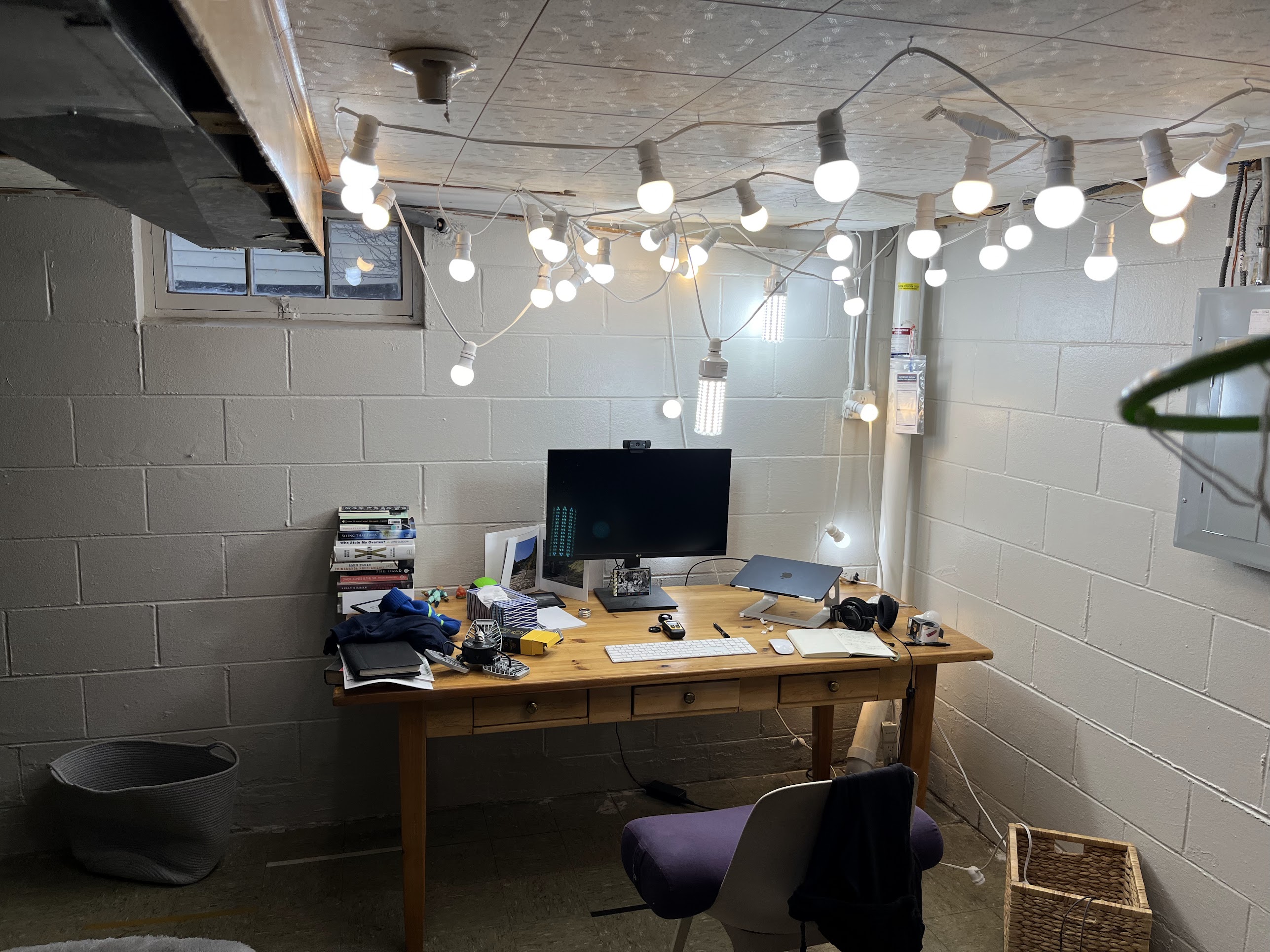
My Super Bright Office, Version 1
The blogger in question, Eliezer Yudkowsky, needed the Lumenator because commercially available SAD lights often don’t give off as much light as they claim. Plus, SAD lights only illuminate a small area and require you to be unnaturally close to the light to get any effect. David Chapman spends considerable digital ink railing against standard SAD lights on the market.
I recommend against buying anything sold as a “light therapy lamp” or “SAD light.” They are underpowered, overpriced, and the advertising claims made for them are misleading, bordering on fraudulent.
A few hundred dollars and ~50 standard lightbulbs later, I had my own version of the Lumenator up and running.
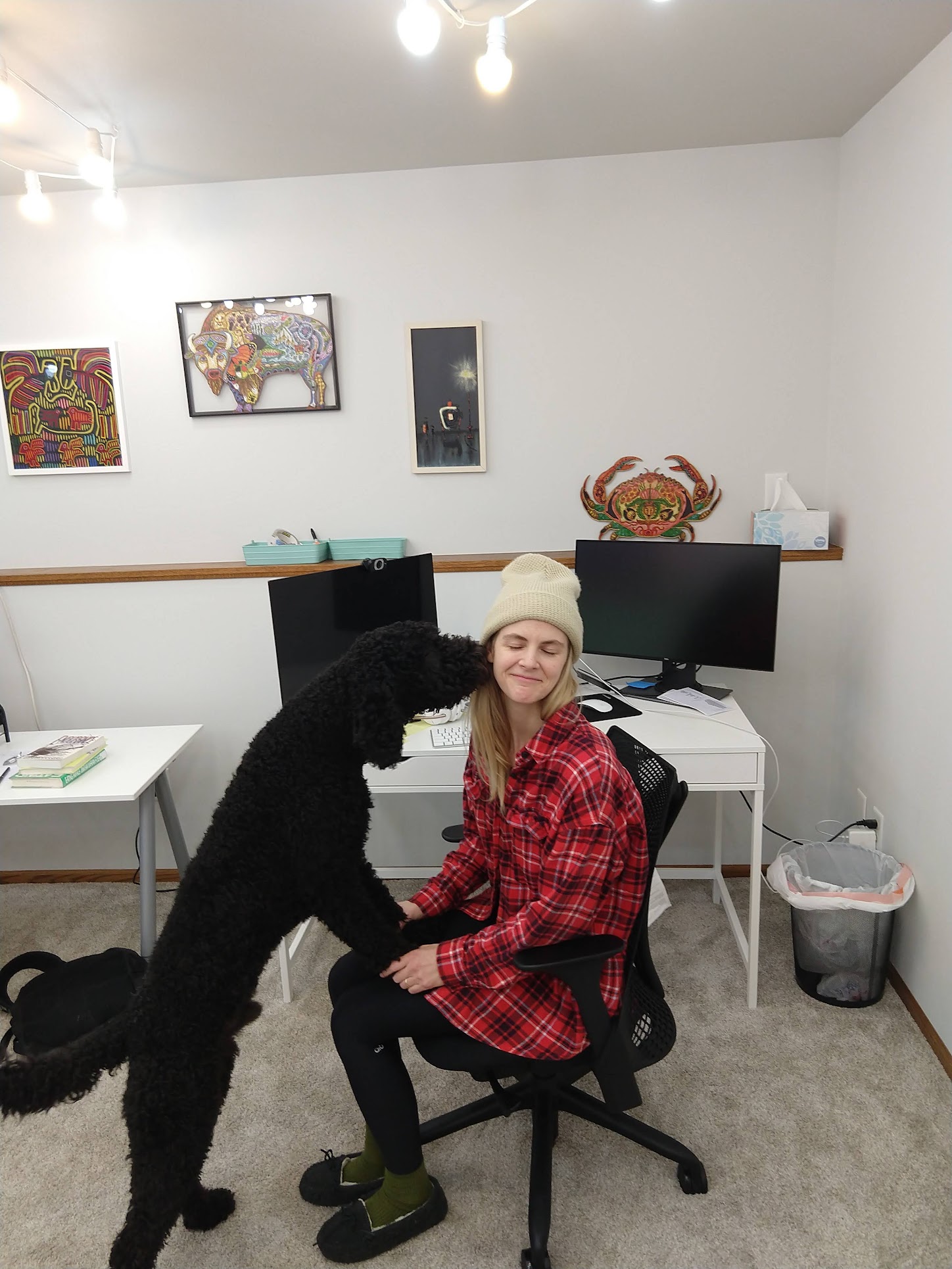
Ashley and Oscar basking in lumen-y goodness back in 2019. I unfortunately never measured the lux level.
This room rocked. I felt more energized working in the brightly lit space.
Ashley, and almost everyone else I brought in to the office, thought it was overkill. Maybe most people are more sensitive to LED light than I am.
My Super Bright Office, Version 2
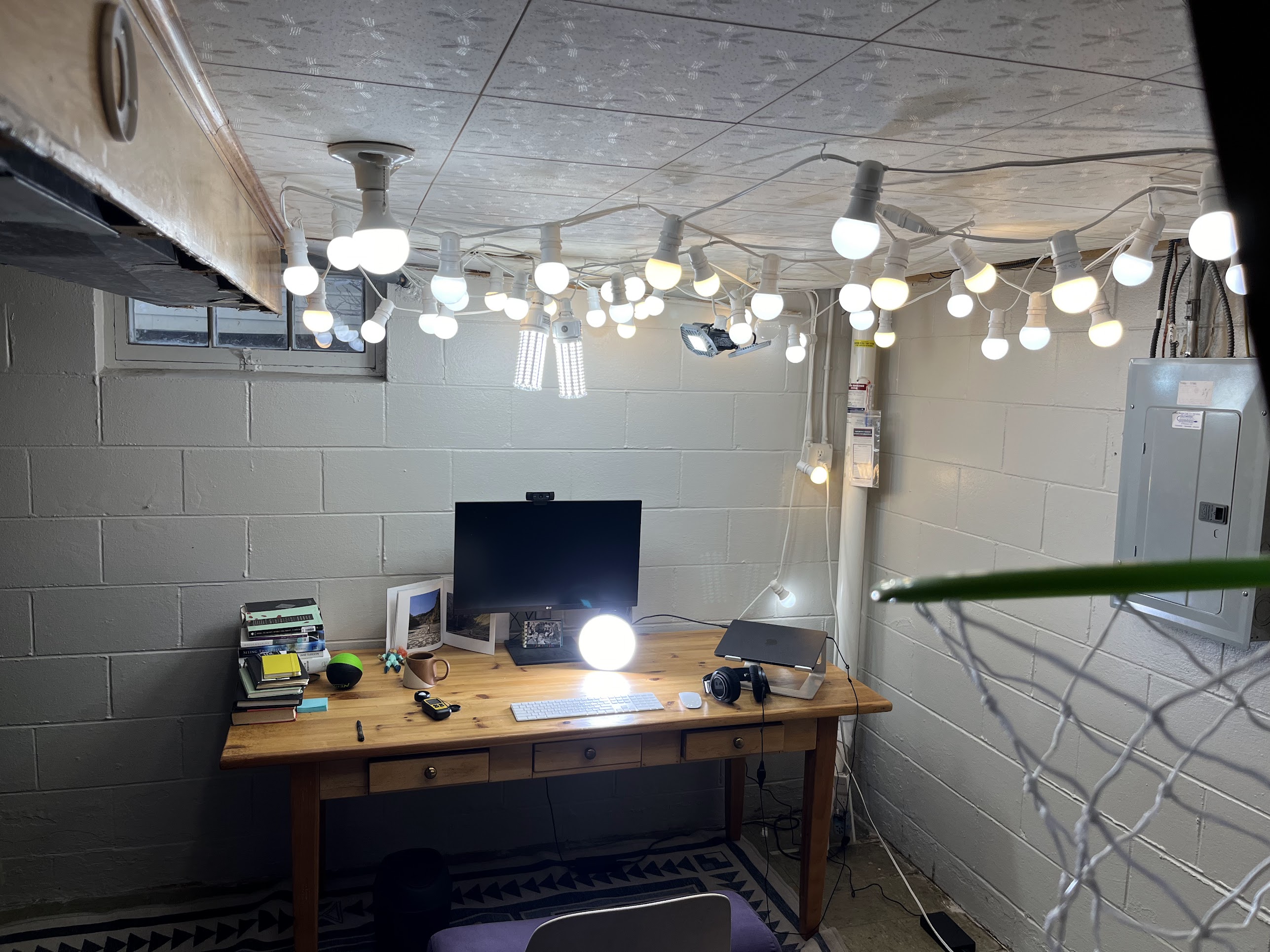
My desk at our place in Milwaukee is in the basemen. It’s the perfect spot for a Lumenator, as the only natural light comes from two small storm windows.
This time, having read Chapman say that he feels better getting even more lux than the recommended 10,000, I got curious: how bright was the Lumenator really? I decided to measure the lux produced by my setup. Then I’d add more lights if I was far below 10,000.
I got $30 light meter from Amazon. To test it out, I used it on a walk in Grant Park in Milwaukee. It was about 3pm in mid-December, and the sun was going down. In direct sunlight, my meter registered ~44,000 lux. That feels accurate based on my research. The testing could now begin.
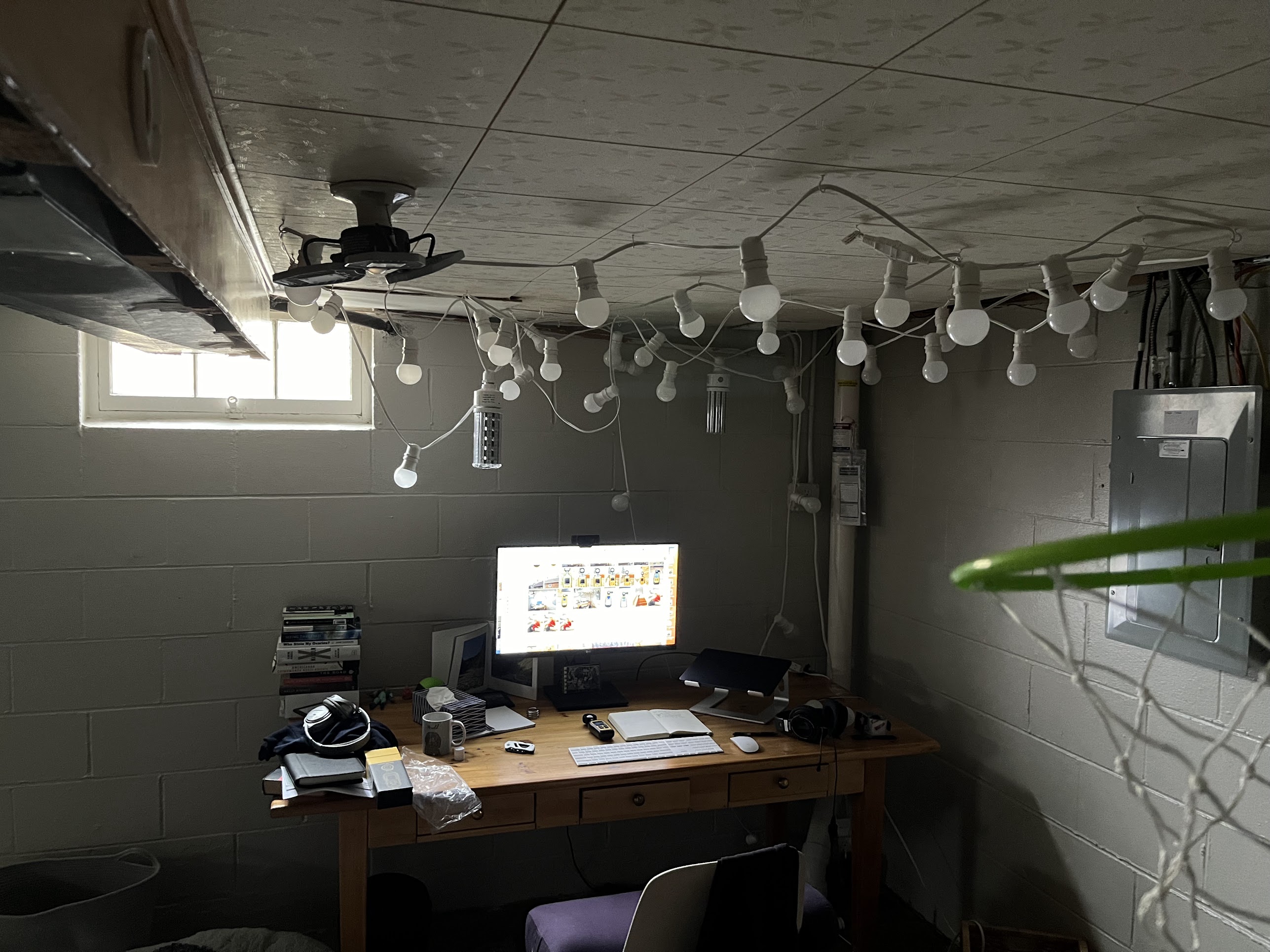
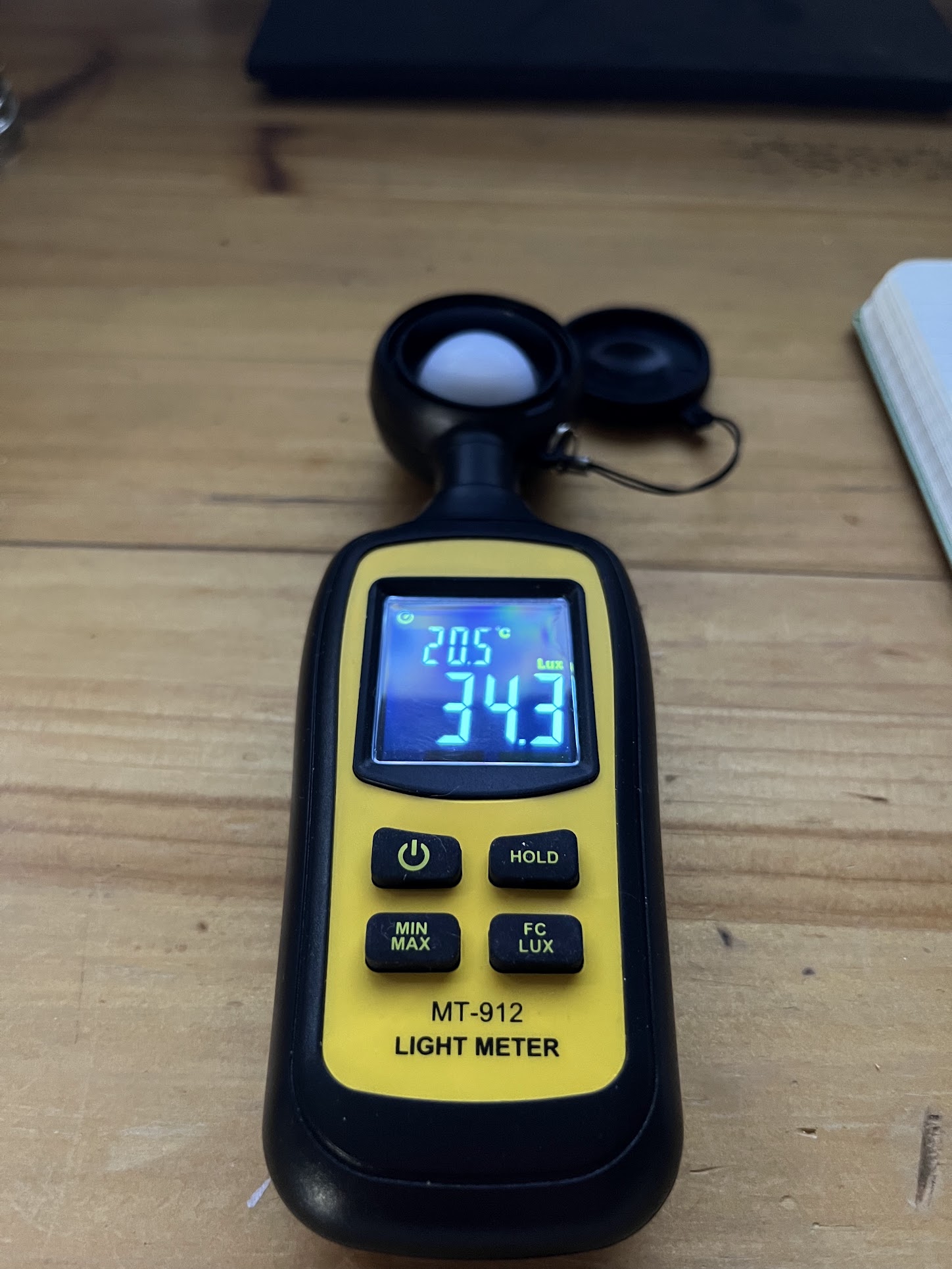
On a cloudy day in January, 2024, I measured the lux in my basement with no lights other than the storm windows and the glow of my computer monitor. It registered 34.
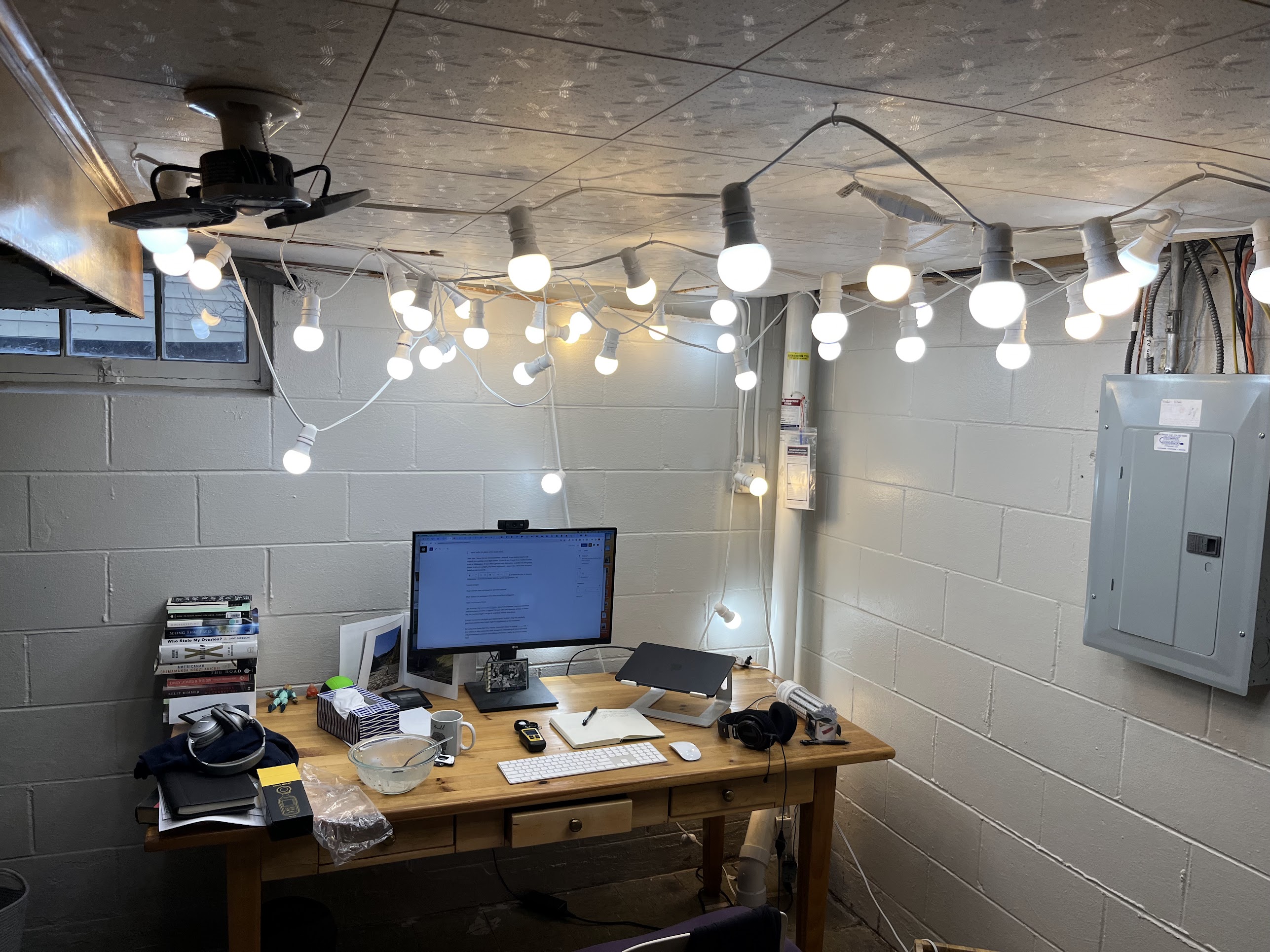
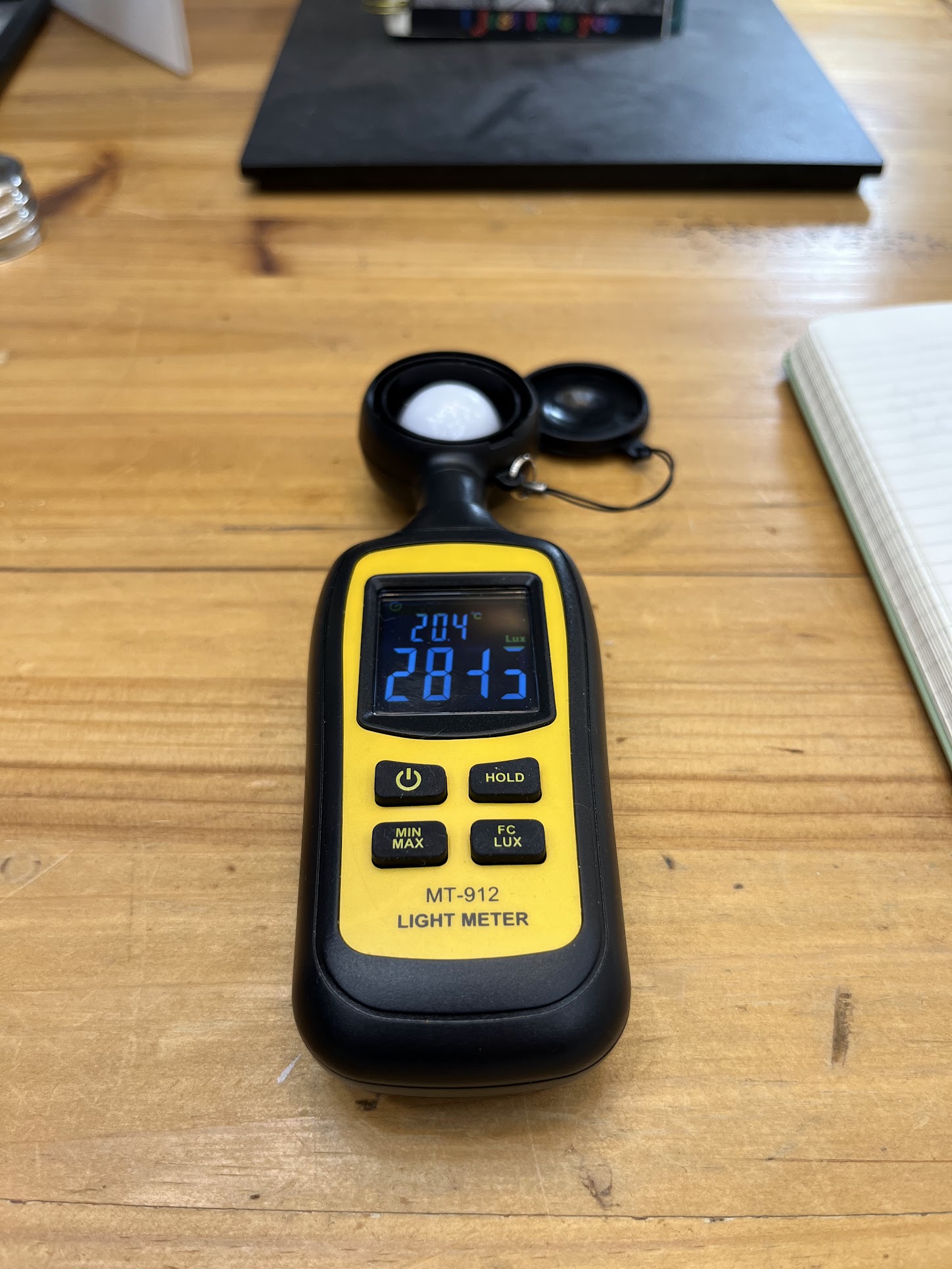
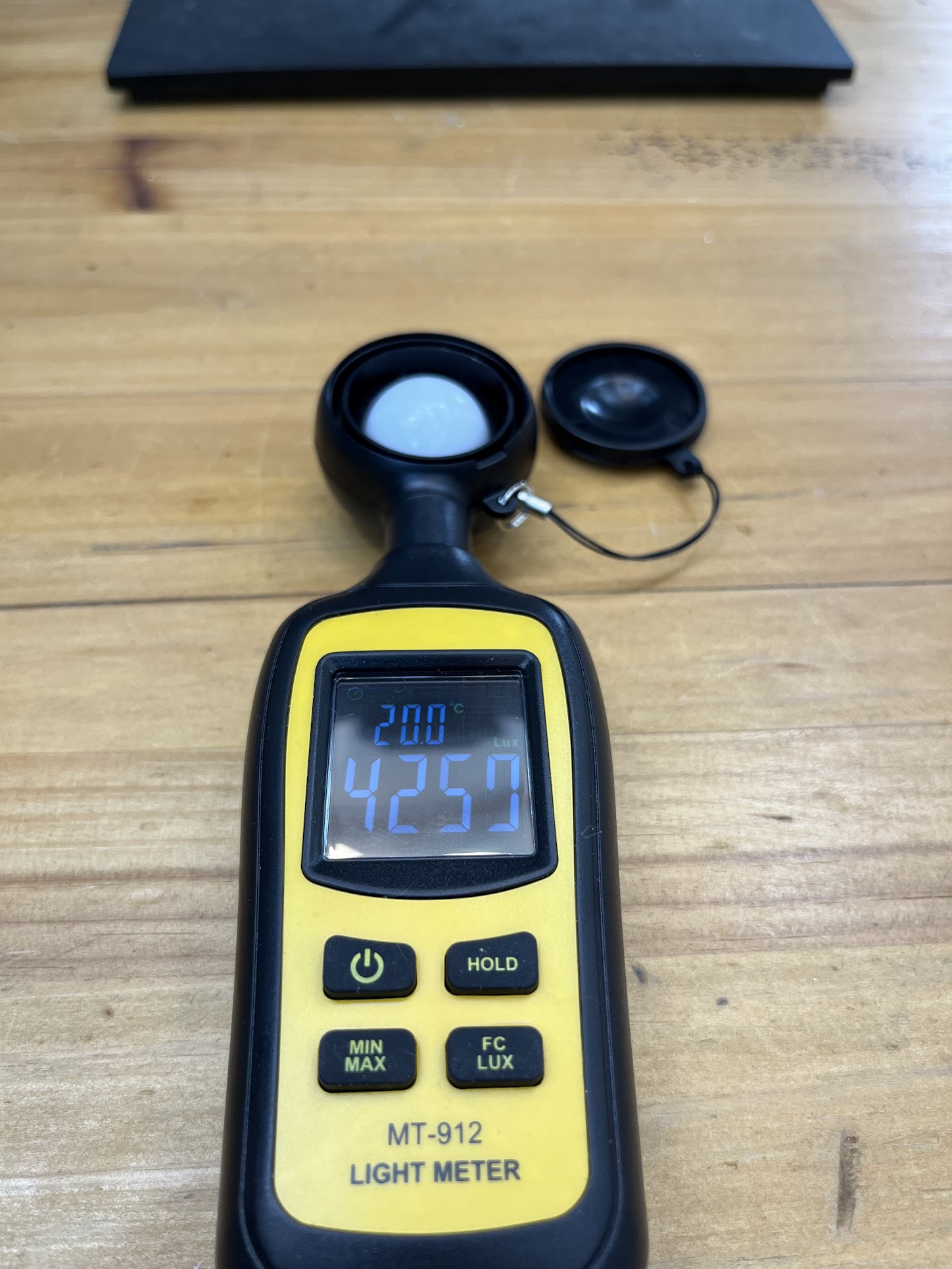
With ~40 of the 8.5w LED bulbs from my old lumenator turned on, the lux shot up to 2800.
I decided to see if my inside brightness was matching the outside brightness. I went out with my meter, stood in my backyard at a random spot, and took a measurement.
It’s hard to see the screen, but it says 11k lux (16.1 is the temperature in celsius)
11,000 lux! About four times brighter than my office. Again, this was an overcast day in the Midwest in January. It wasn’t completely grey out, but it certainly wasn’t sunny. The sky looked like this:
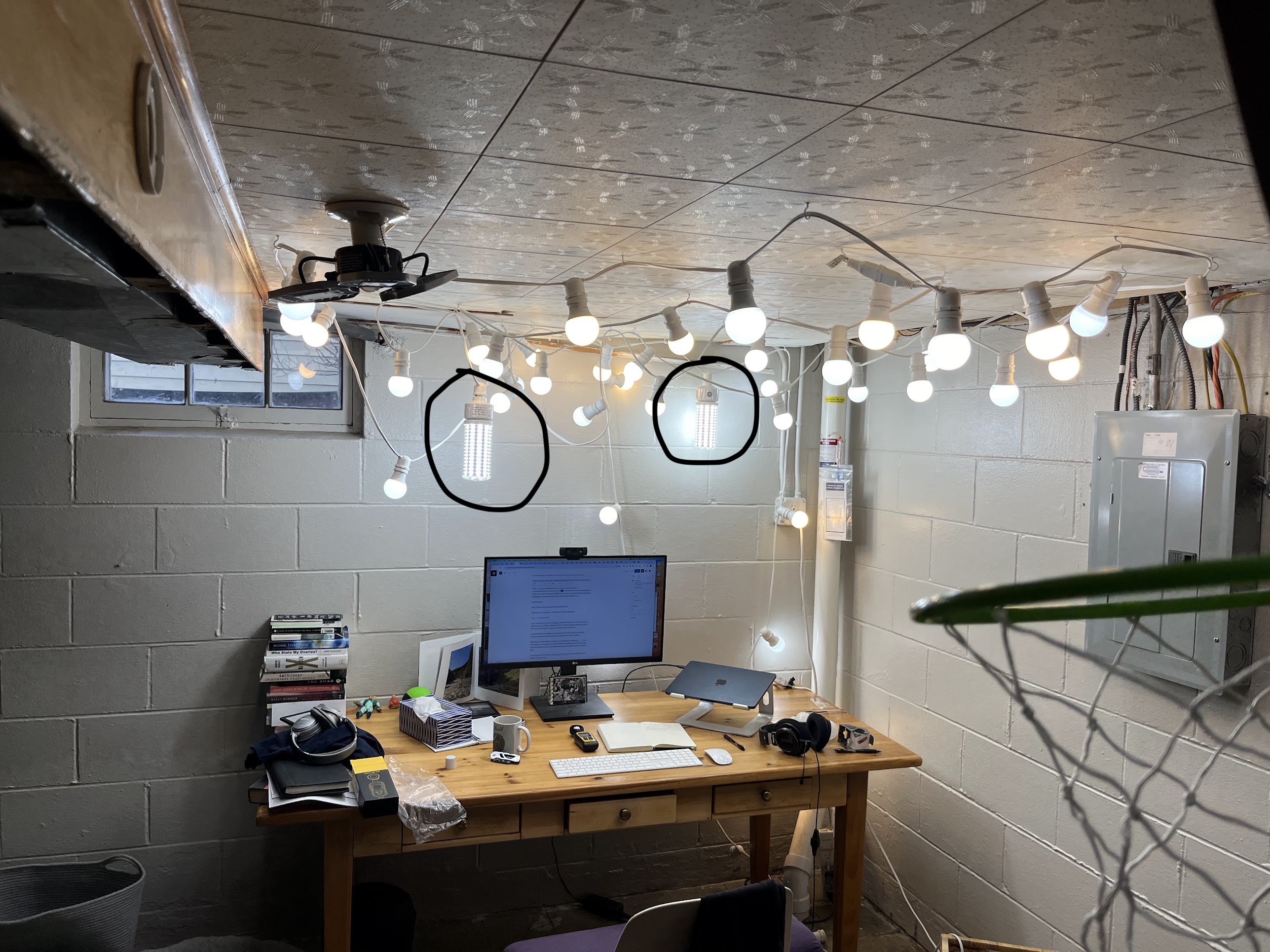
It was time to call in the big guns. I had purchased a couple $30 corn cob LED lights, based on Chapman’s recommendation and other users reviews, and I was now ready to deploy them. The corn cobs are giant 100 watt lightbulbs. When the description for a light says they are for garages, barns, workshops, warehouses, factories, and parking lots, I know I’m on the right track.
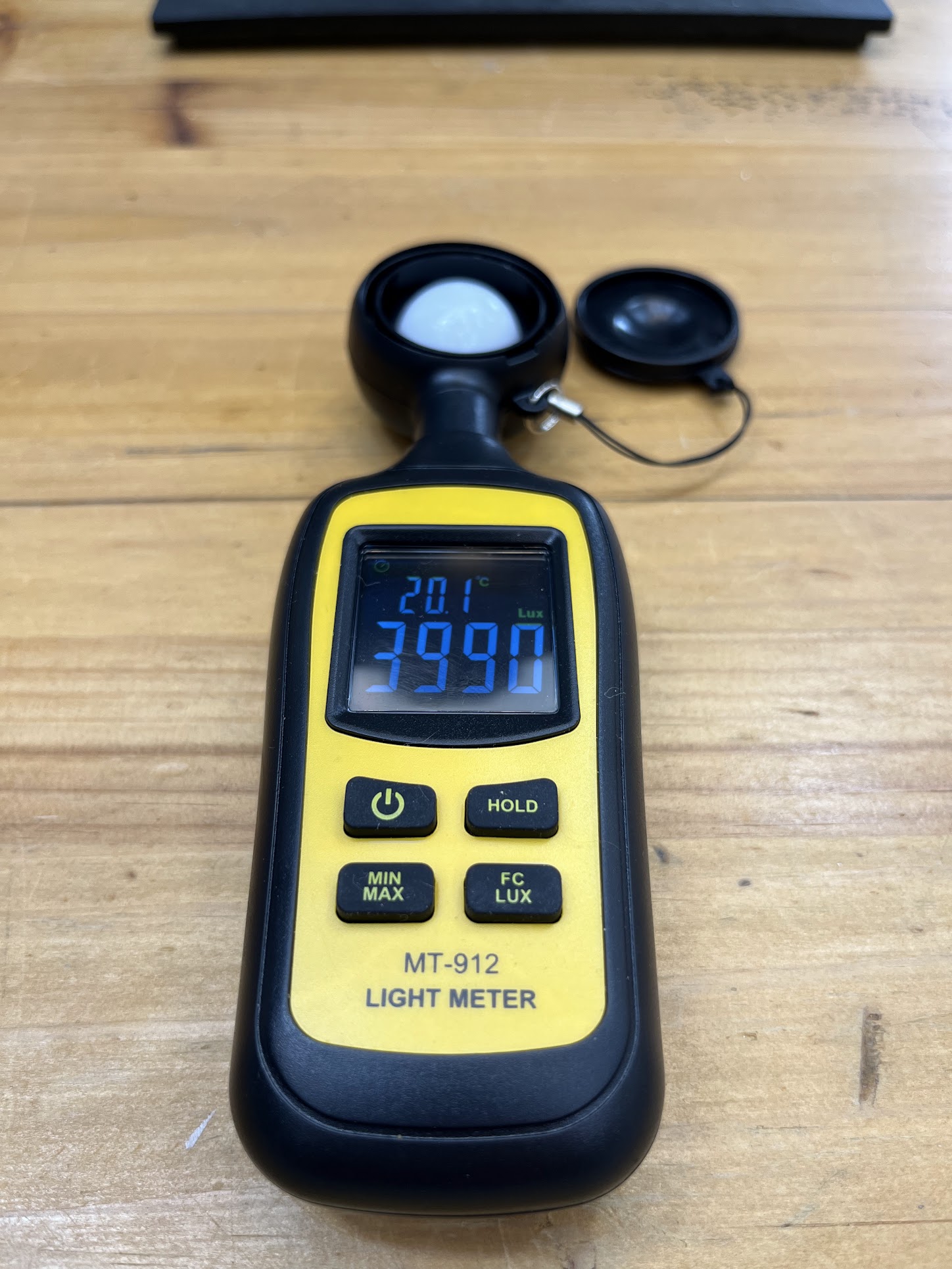
I replaced two of my 8.5W Lumenator bulbs with the corn cobs and did another measurement.
The corn cobs got me over 1000 extra lux.
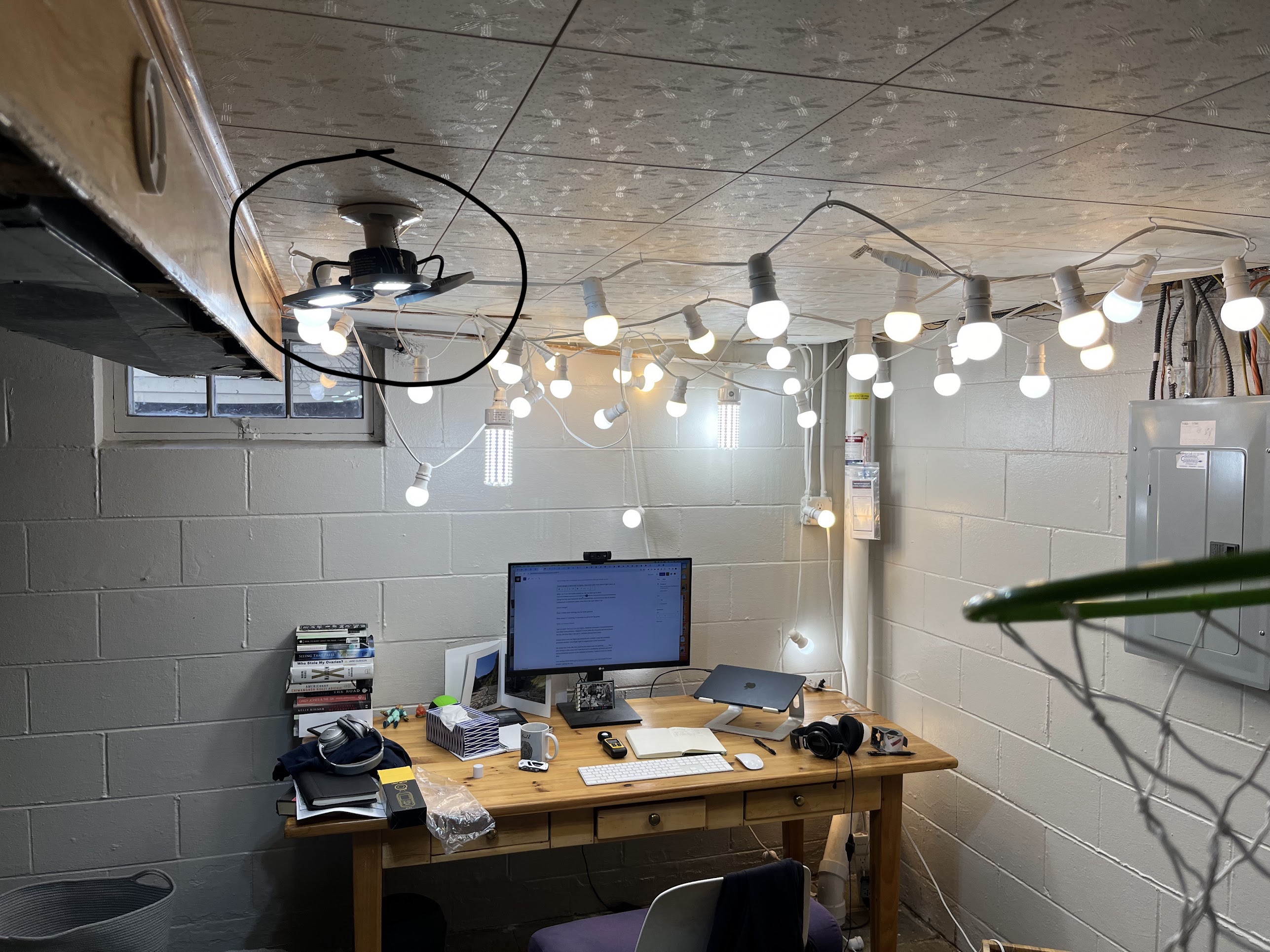
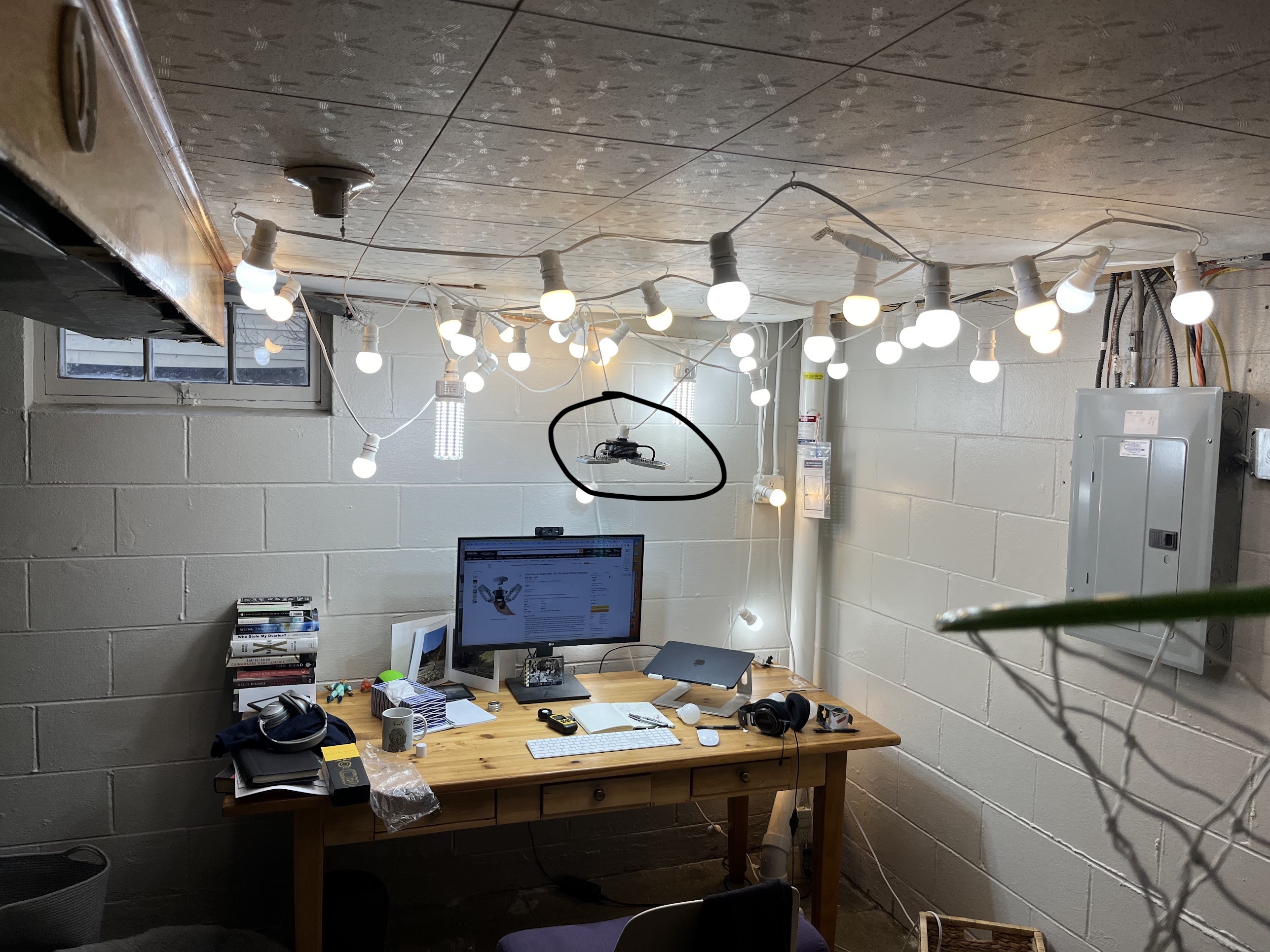
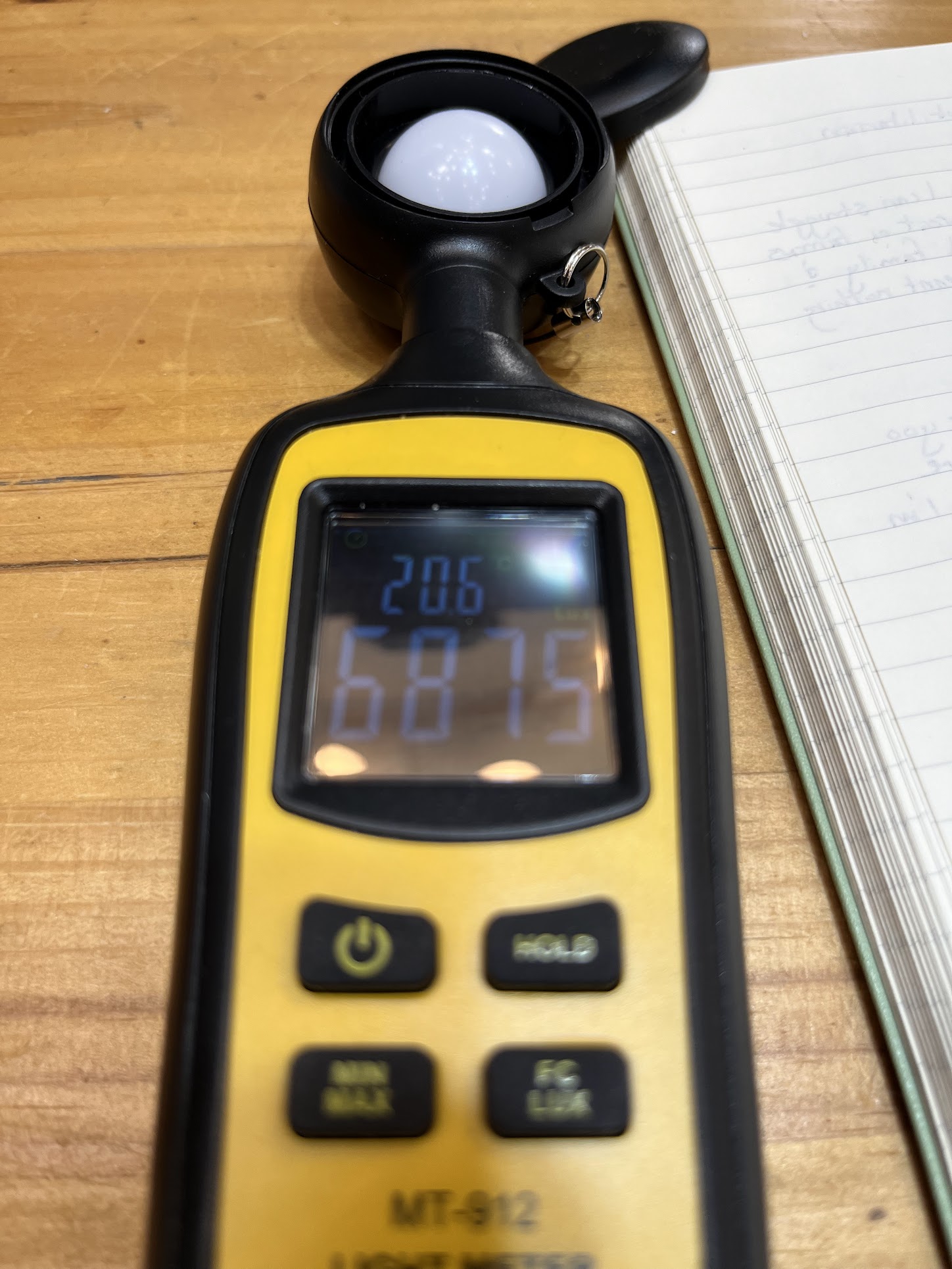
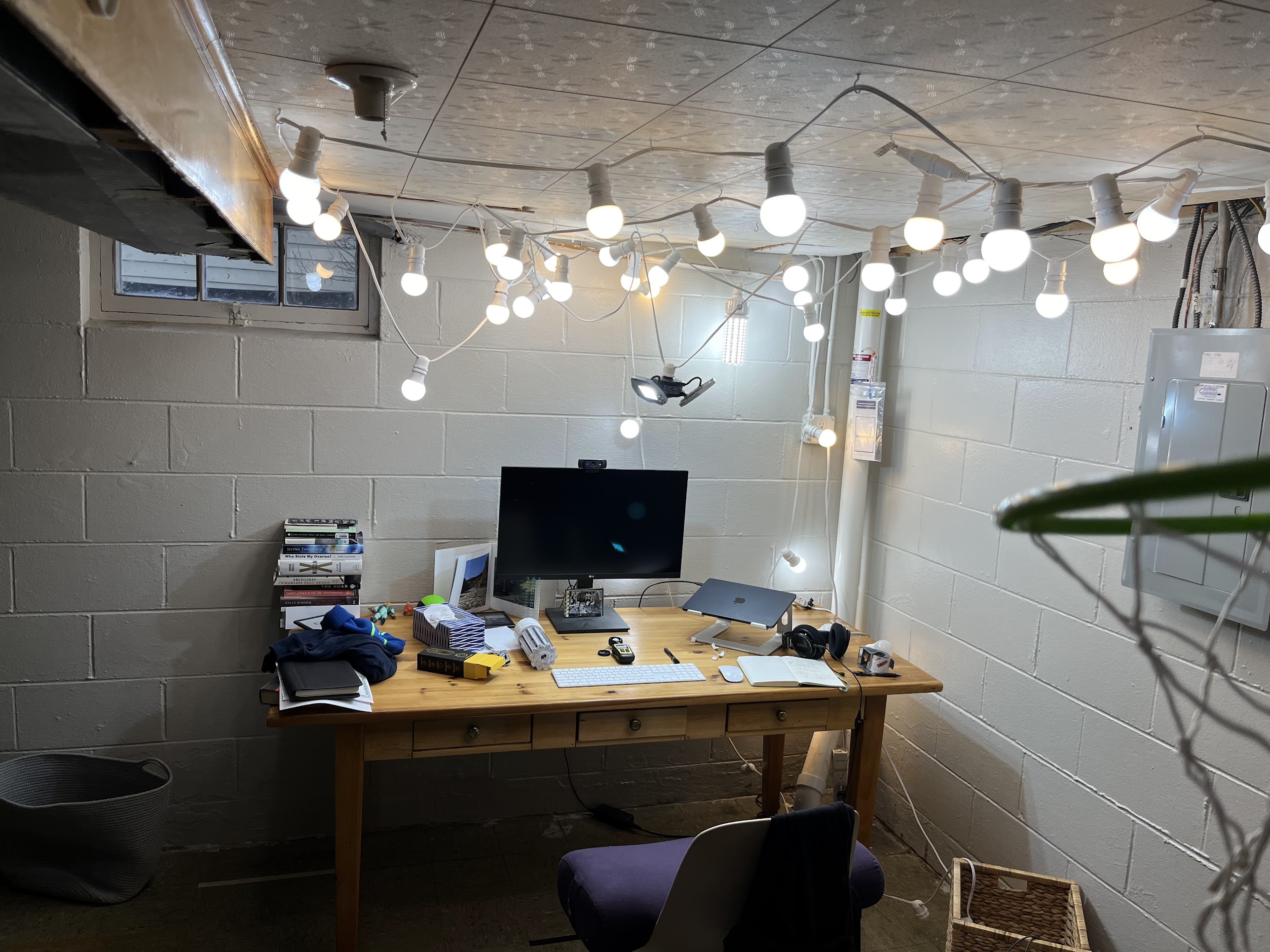
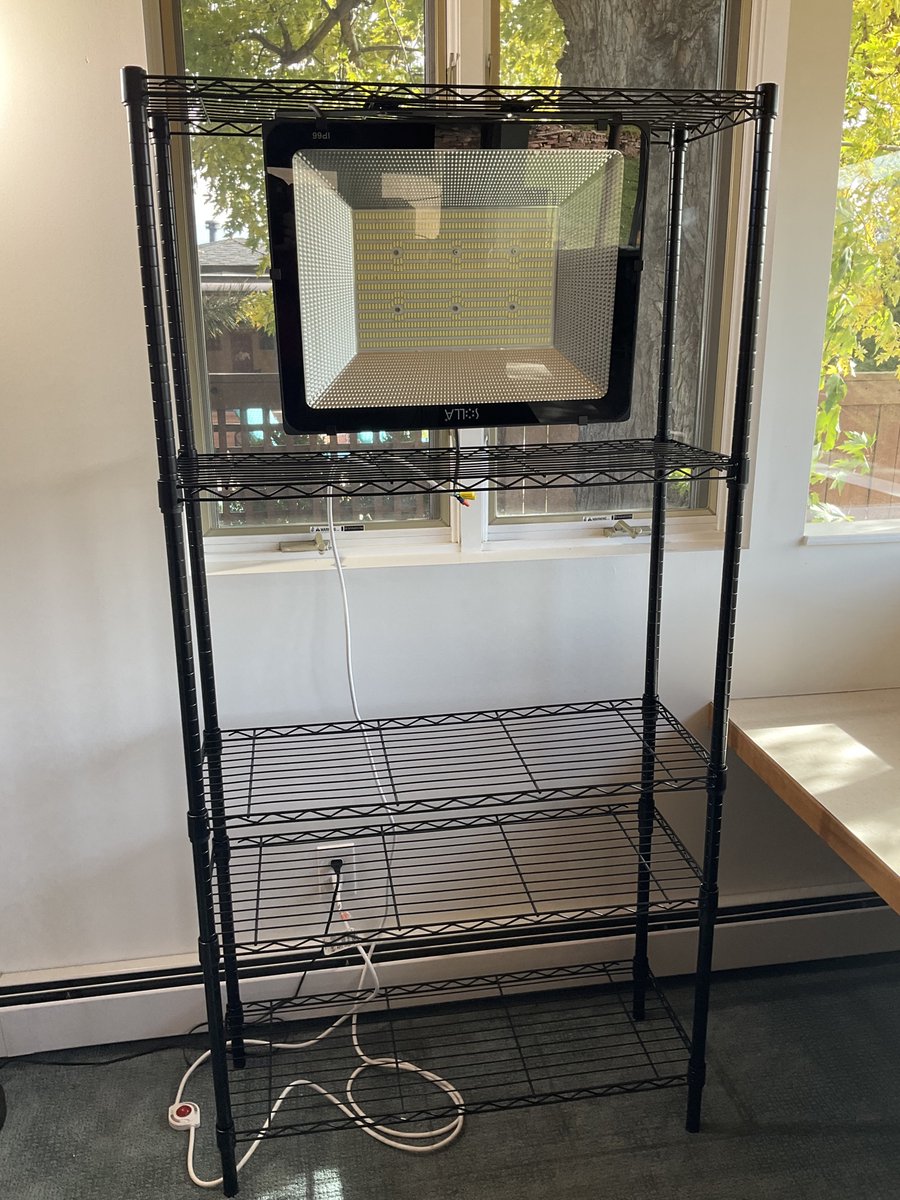
I then realized I had another quick way to get more light. The previous owners left a three pronged flat panel led light in the basement. I fired it up and checked the light meter.
That gave me a solid 250 lux improvement, for “free.”
I then decided to see what would happen if I put the flat panel LED light directly above my workspace.
Now we’re talking. That brought a 2500 boost in lux. But, importantly, all these measurements were at the level of my desk. To really see the impact I was having, I wanted to investigate how much lux was getting into my eyes.
Get the lights close to your eyeballs to become a lux maxxer
Your proximity to the light source is paramount to getting more lux. That might sound obvious, but it’s not so intuitive when you’re actually manipulating the lights.
I think that’s because of how your irises naturally contract and open depending on the available light. All the setups I’ve documented in this post looked very similar to me. It didn’t feel much brighter at my desk when I moved the flat panel light a mere 5 feet closer, but the meter indicated a huge boost in light.
I decided to do some measurements at eye level, while changing the positioning of one of the corn cobs and the flat panel.
I found that the turbo boost in lux I achieved from moving the flat panel closer went away. Yes, if I pointed every panel straight down, it would blast a whole bunch of lumens down at my desk. But most of that was not reaching my eyes. Even if I adjusted the panels to point more toward my face, they still produced more light at the desk level than a corn cob in the same position.
The following two pictures have a 500 lux difference at the desk level (higher desk levels were with the flat panel hanging above me) but the same lux at the eye level.
Doing all this makes it clear why some people build aluminum foil backings behind their corn cobs to redirect the maximal amount of light toward where they are sitting, and why large flat panel LEDs are popular amongst the lighting nerd crowd.
Part of David Chapman’s setup
You really do need a lot of light concentrated in a small area to get that lux number to increase. The cylindrical shape of a standard bulb is not ideal for our purposes.
Thankfully, the lighting industry is more than ready to meet the challenge of blasting oodles of light into a concentrated area. My obsession took a fun turn once I expanded my research to include more professional grade setups.
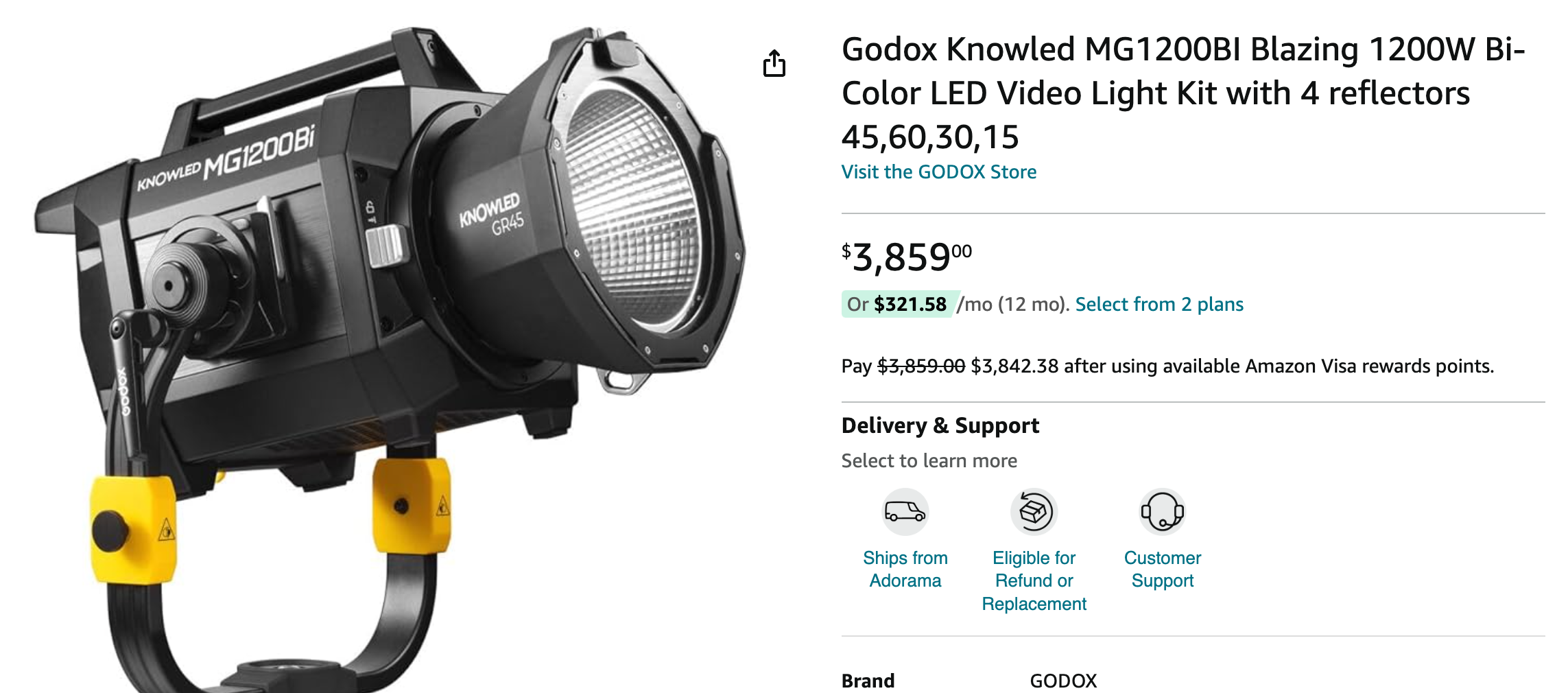
No, I did not sell one of our cars and use the funds to purchase a $4,000 light. (yet)
I did get a baby version though, called the Godox LA150D. It’s still pricey, at $179, but well within the means of budget conscious lighting sickos. I like it because it has a very high color index rating (CRI). I honestly don’t fully understand what that means but it seems good and like it should make the light feel more “natural.”
More importantly, with my Godox fired up, I registered 11,500 lux at eye level. (directly next to the light it measured 92,000 lux!)
I would include a picture of the reading on my meter but the light is so bright it washes out the numbers on my light meter screen.
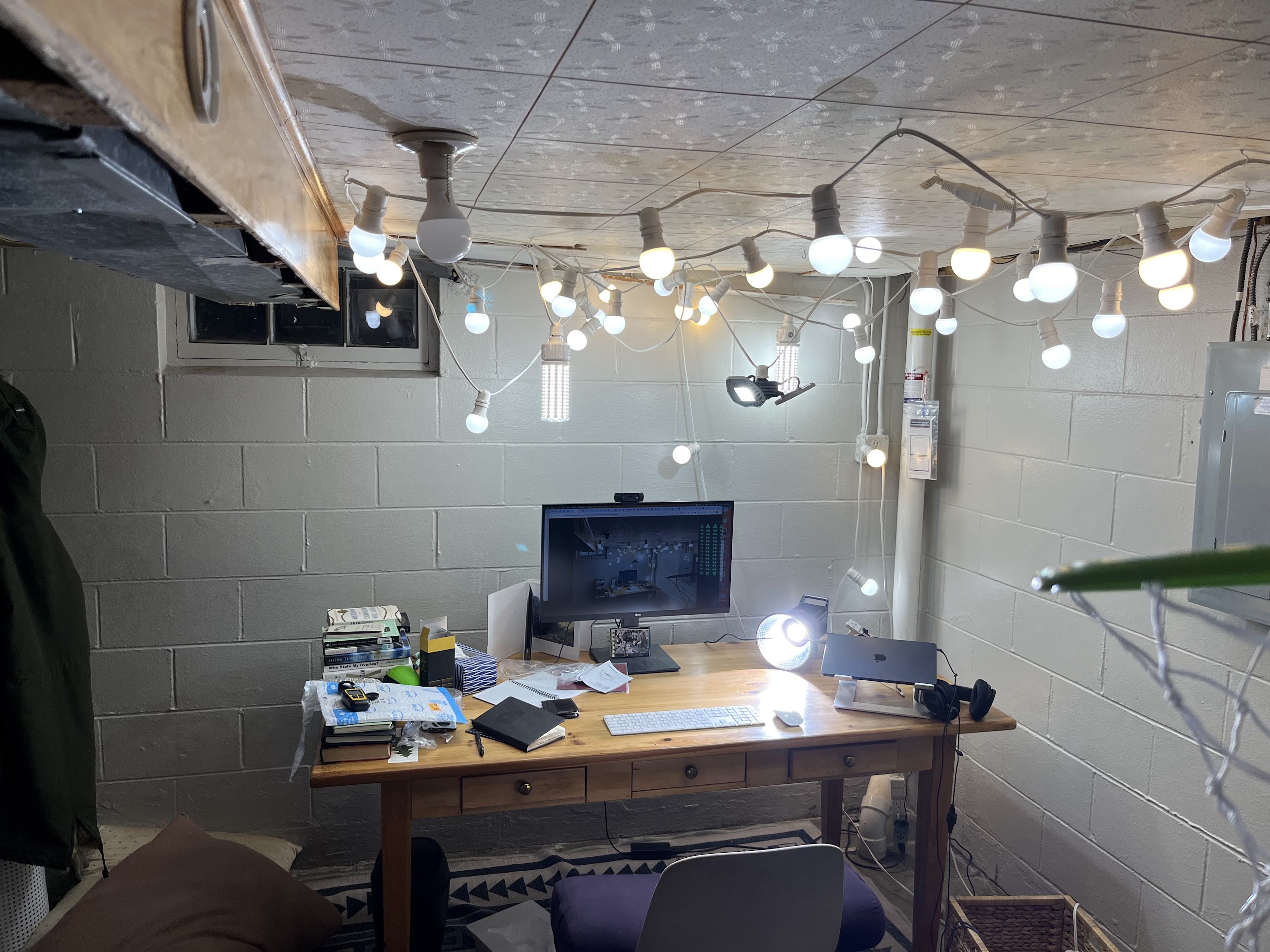
Finally, after turning on 37 standard bulbs, an ultra bright multi pronged LED garage light thing, two ginormous corn cobs, and an industrial strength stage light so intense it’s equipped with it’s own fan, I was able to achieve the equivalent lux of being outside on an overcast winter day in Wisconsin.
I have a new appreciation for just how bright the sun is. If that deep insight is not worth tens of hours of work, hundreds of dollars, and dealing with increasingly desperate pleas from your significant other to not burn the house down, we have different ideas of fun.
Making the bright office more tolerable
The really bright lights can be harsh on the eyes. I decided to sacrifice a bit of lux in favor of making the room much more pleasant to be in.
I raised up the corn cobs and the flat panel and purchased a $12 diffuser screen for the Godox. Both these changes reduced the lux count reaching my eyes but made the room much nicer to be in for extended periods of time. The corn cobs are now just barely noticeable at the top of my field of vision while working at my desk.
I then added the rest of my old, small, lumenator 1.0 bulbs back to the ceiling and moved one corn cobs closer to my head. With that, I was able to achieve roughly the same lux at eye level (~11k) as before I made the adjustments and added the diffuser.
I might eventually get a tripod for the Godox, but I’ve spent enough time and money on this project for now.
Final version as of January, 2023
Is all that bright light bad for your eyes?
I don’t think so, based on some cursory research. You should obviously not stare directly at a bright light source, but I hope that goes without saying. Just a glance at the Godox while turned on to full blast is enough to kick in some deep rooted instincts around not looking at the sun. I will not be messing around with that.
Some people worry about getting too much blue light specifically, being that it can disrupt sleep. The American Academy of Opthamology says that regular blue light exposure is fine. Blue light is also the part of the light spectrum many think is responsible for boosting mood and wakefulness, so the more the merrier in my opinion.
There are studies in rats and mice showing very bright LED light causing macular degeneration. Similar with Albino people. Being that I am neither albino or a rodent, I’m not putting too much stock in those studies for now. It’s something to monitor, though.
When the Godox is on and pointed directly at me I am prone to squinting, which might give me more eye wrinkles or have other downstream effect. But I do my best to let my eyes and face relax, and it gets easier with practice. I can always This is a risk I’m willing to take.
Overall, I like Chapman’s take on the risks from very bright light. This is from the comments section of one of his articles:
Most of the many different theories in it about why LEDs might be bad for you are biologically or physically implausible.
That said, we can’t be absolutely sure there are no bad effects of LED lighting. Not enough research has been done to rule out the possibility. However, it’s unlikely that enough research will ever be done, on this or most other low-probability health risks, so one has to weigh likely benefits vs risks.
For me, the benefits of bright LEDs seem large, and the risks seem small, so it’s an easy choice, but everyone has to make the choice for themselves.
I have become light king, destroyer of SAD
I used to stare enviously out my tiny window, slightly annoyed that I was working in dark basement. Now I look out upon that grey afternoon sky and revel in the fact that I get to live in a world where LEDs are so cheap and good that I can almost literally recreate the sun indoors. It feels great.
The new setup already seems to be lessening the afternoon energy slumps I am prone to. Twice recently I sat down to do some afternoon writing and expected to want a little nicotine gum. I was feeling low energy, and I sometimes like to use a little nicotine when I write regardless. After turning on every light, my energy and mood improved within minutes. Next thing I knew I had written for nearly an hour. I’d periodically look at the package of gum on my desk but not feel it was necessary. Bright light: nature’s nicotine.
As far as usage, I don’t run all the lights every minute I’m working. I’m still experimenting with what works best for me. Going 100% full blast for like an hour in the morning and another hour in the afternoon seems to work well for raising energy levels.
Brightening up my home office hits the middle of my Venn diagram for projects I tend to engage in:
strong potential for health benefits
overlooked by most of society, makes me feel cutting edge
going the DIY route is hard enough to make me feel accomplished but not so hard it requires actual handyman skills
provides an instant conversation starter when people visit
affordable to get started, but with plenty of opportunity to drool over all the expensive add-ons that might provide marginal improvements
It helps to have a saintly wife who lets you have fun with this kind of stuff.
I look forward to attributing all future personal and professional success to the lux count I bathe in every day. Maybe Lumenator 3.0 will give me a winter tan as an added bonus.
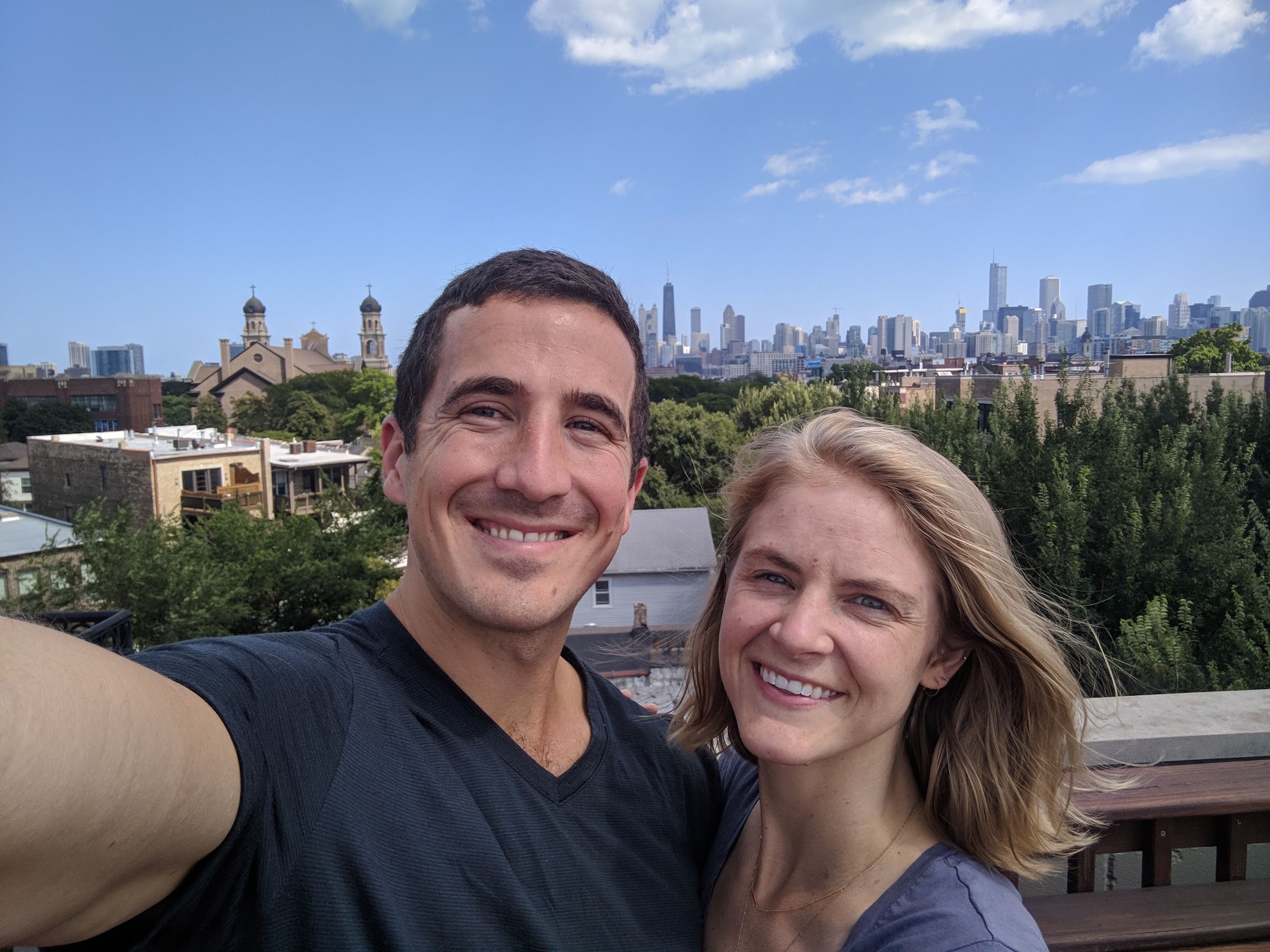
Ashley and I recently counted up how many times we’ve moved since we started dating. The number stands at 12. Somehow, we’ve managed to move more than once per year.
Move number 13 is about to happen. Hopefully it will be the last one for a long while.
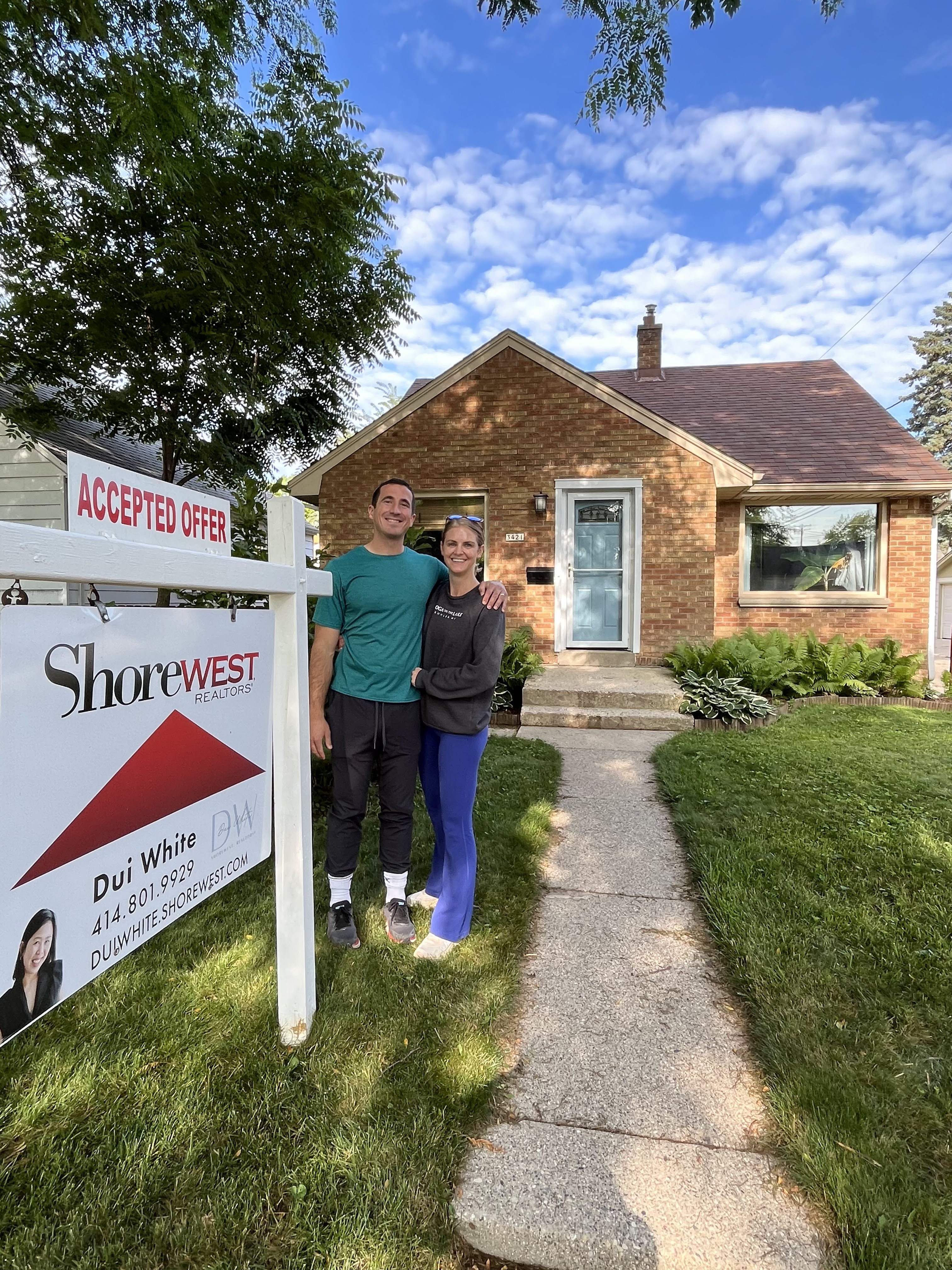
We got a house in the Bay View neighborhood in Milwaukee. It’s walkable and bikable. It’s close to parks, Lake Michigan, and some awesome restaurants. We’re excited!
Yes, there is a long winter. Thankfully, I have firmly and irrevocably convinced myself that the winters here are not that bad. They actually have a lot of positives. Think of the community building aspects of a long winter, people!
A friend told me it’s cool to tuck your pants into your socks these days. I’m still determining if I’m cool enough to pull it off.
As the latest move approaches, I’ve been reflecting on the pros and cons of moving all the time.
Pros of moving all the time:
Experiencing new areas like a local as opposed to dipping in and out for a vacation.
Friends and family get really excited when you tell them you’re moving nearby.
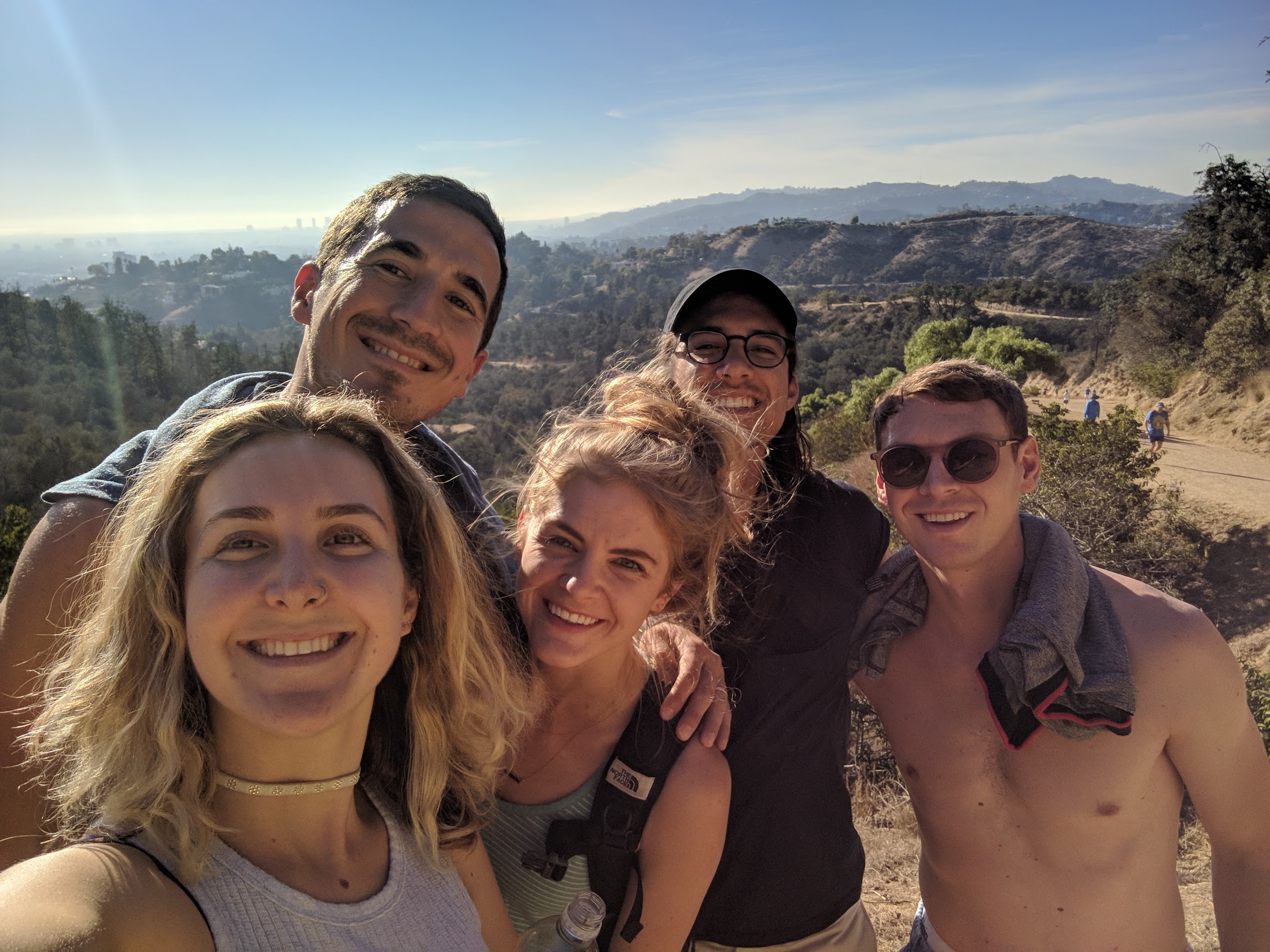
Spending quality time living close to far-flung friends and family members, meeting their new babies, etc.
Baby Charlie checking out the BK apartment, showing no fear Always fun running hills and getting views in SF with Tim.
Learning about different cultures.
Driving moves are a great excuse to visit friends who live along the route.
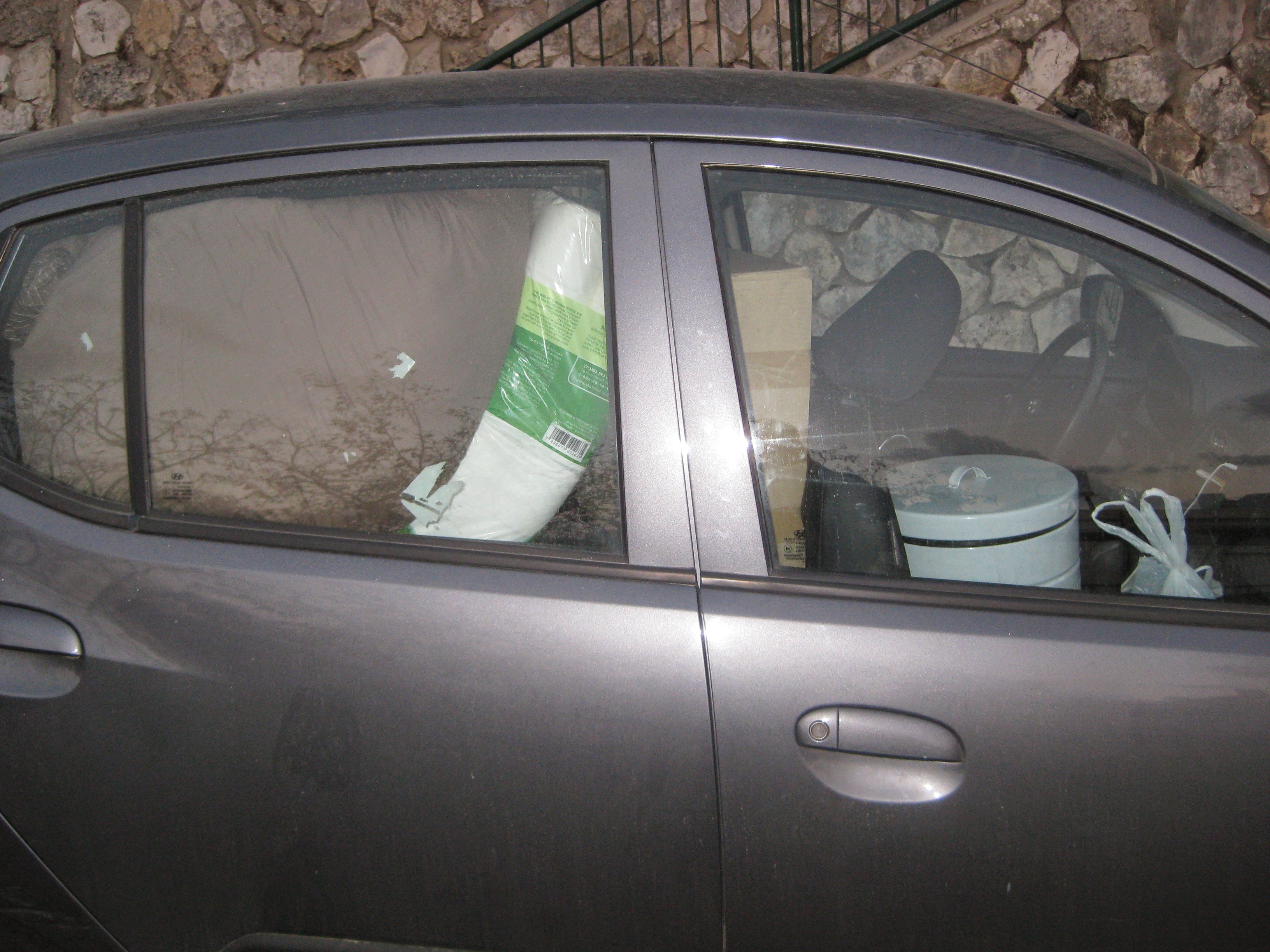
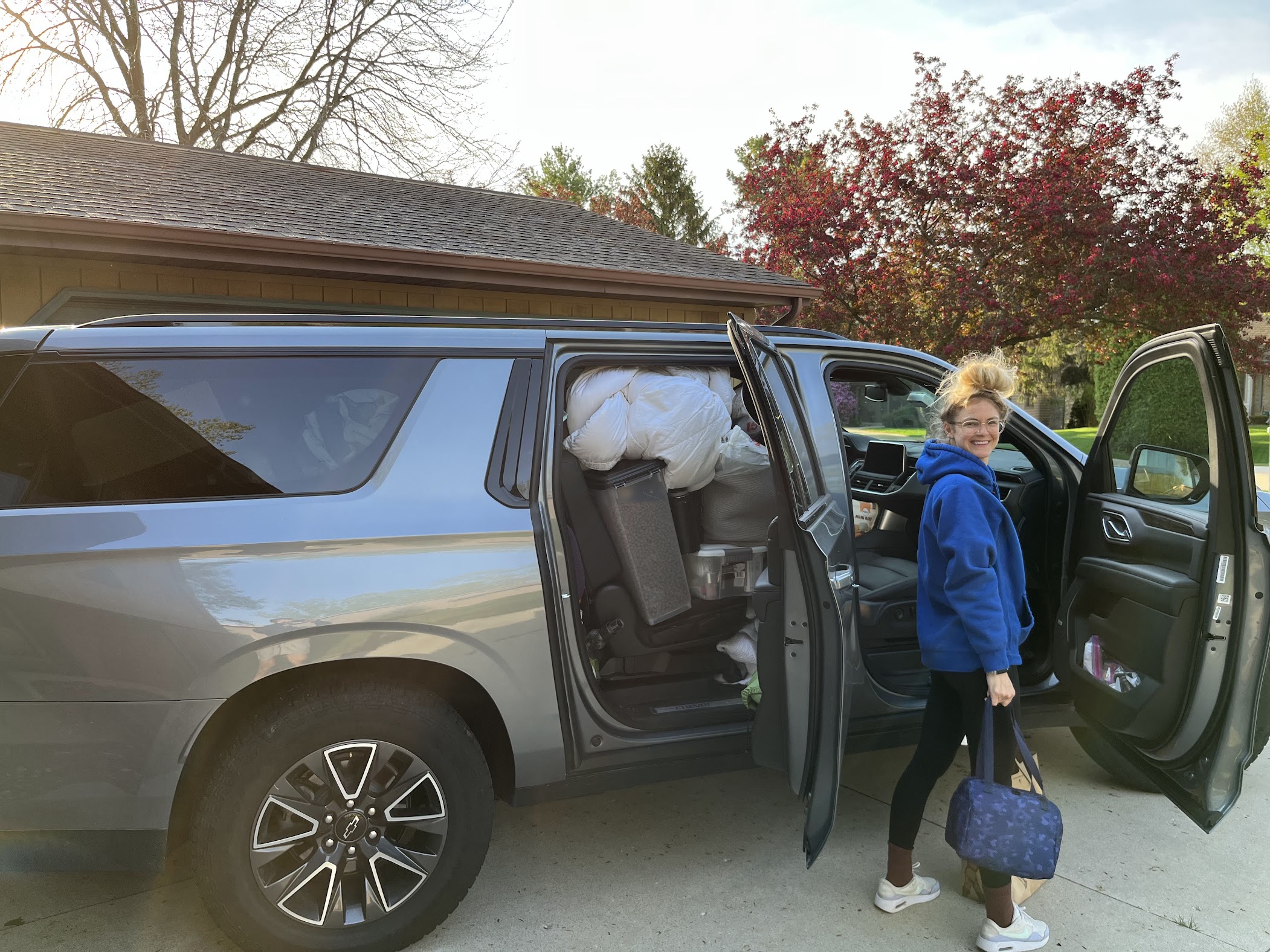
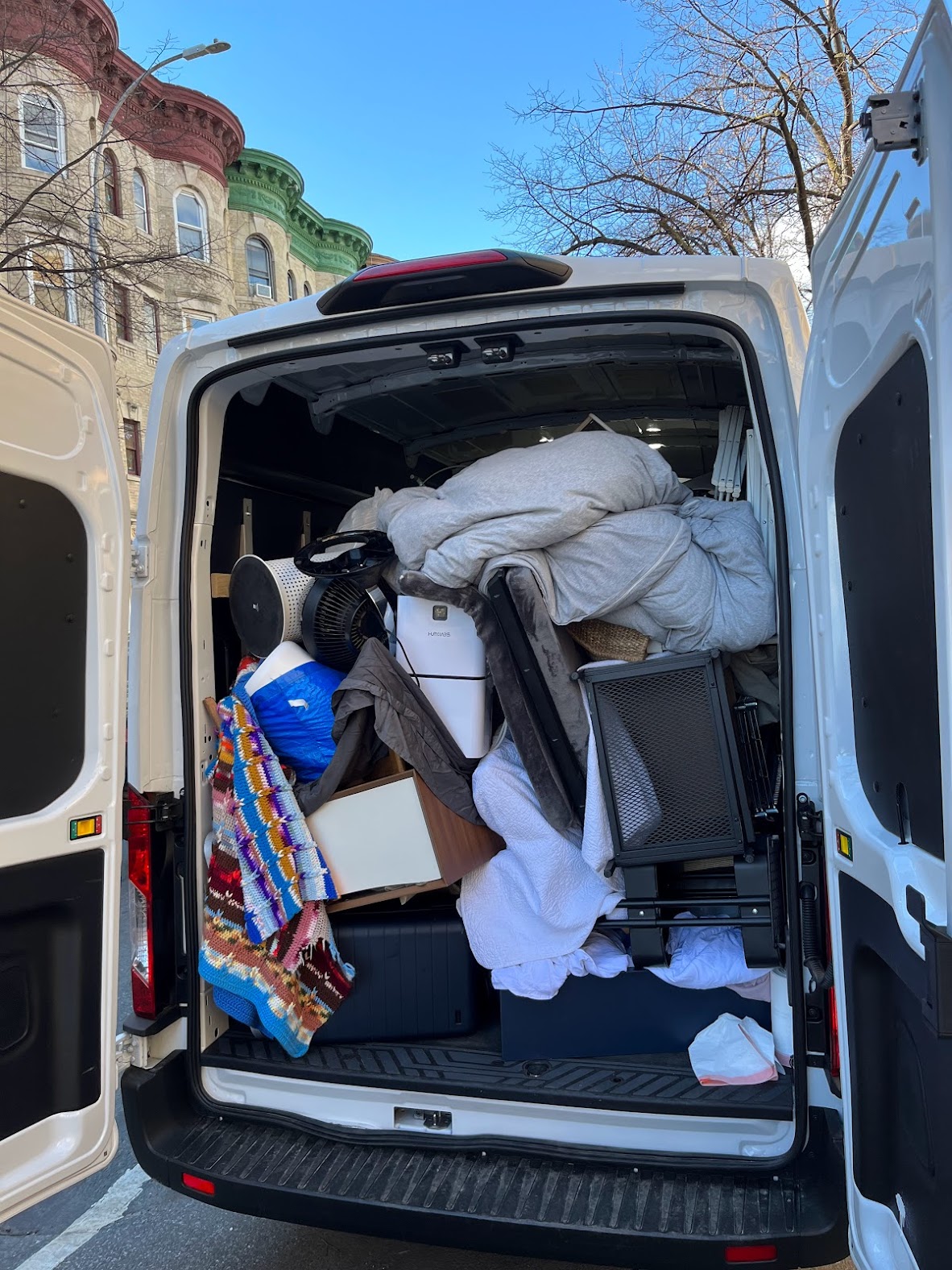
Improving your spatial awareness skills by figuring out how to best pack your stuff into every nook and cranny of a car.
Moving apartments in Israel Moving to NYC (the second time)Moving back to Wisconsin. This was more stable than it looks.
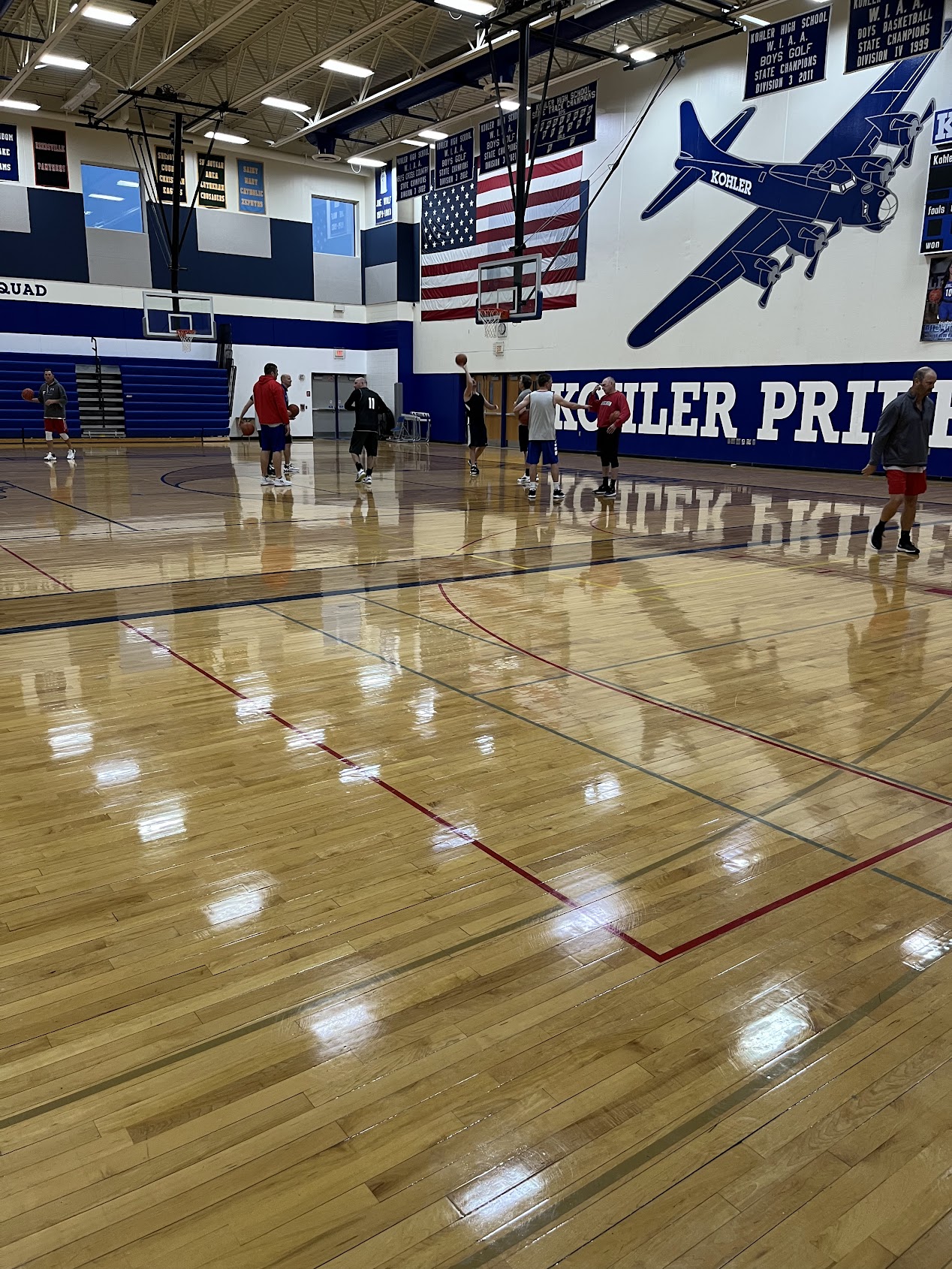
Establishing a wide network of new friends, professional connections, and pickup basketball enthusiasts.
Fun morning runs in Kohler, WIAmazing guys trip that I never would have found out about were it not for pickup hoops in Chicago.
Learning you have awesome friends and family who will let you crash with them while you find a place.
An air mattress at Ashley’s brother’s place in SF. The inimitable Oslo was our suite mate.Crashing at Casa de Ross while apartment hunting in Chicago.
Providing joy to neighbors and local moms hustling on the Facebook marketplace when you firesale all your stuff on the cheap because oh crap the move out date is approaching really fast.
Experiencing Prospect Park in Brooklyn during morning off-leash dog hours — this should be a bucket list item for all dog owners.
Dog heaven
Sweating it out with some incredibly kind Mormon missionaries who helped us lift heavy things when they saw us struggling to get up to our second floor place in Studio City, CA.
Learning that, with enough determination and layers, you can go for walks in Chicago when it’s -50F
Brave Ashley at Navy Pier in -50F. The city had to light the train tracks on fire it was so cold. That’s frozen Lake Michigan behind her.
Living in a fun, new place is a great excuse for people to visit
Me and the dogs got to crash girl’s weekend NYCShoutout to mom for visiting the frigid Sheboygan woods and for helping us get our first dog, Oscar. Tyler and Erik and Catie visiting LA.Golden Gate bridge bike ride with Andy.
Cons of moving all the time:
Friends and family get sad when you tell them you’re up and leaving. You have to have fun yet also bittersweet goodbye events.
One of many goodbye dinners we’ve had over the years. Love these people!
Moving all the time makes it impossible to get rooted. You’re less likely to get involved with making a place better. Sheboygan was the place we lived the longest, so it was the hardest to leave. I still miss the woods near our house.
Snow walks are honestly a great time.
You tend to invest less in relationships once you know you’re going to move :(
It’s expensive!
You might end up in an ancient Brooklyn apartment building below a unit the landlords have neglected to maintain. The pipes could burst above you just as you’re sitting down to dinner, causing it rain from the ceiling. When you call your superintendent to help you’ll get his voicemail. Firefighters have to get involved.
Ashley, calm under pressure, figuring it all out.
The actual act of moving can be physically and mentally draining.
You have to switch pickup basketball games and lose a lot of those relationships
My LA pickup game was a fun one, this was my final day.
Those nights when you first get to a place or have just sold all your stuff and you have to sleep in a sleeping bag on the floor are fun in theory, less so in practice.
Having to part with a dope array of house plants that your wife worked super hard to cultivate. It’s also tough to cut books, furniture, and vinyl records you like.
A very good use of my college basketball per diem money.
Getting angry emails from your landlord in Israel because you didn’t clean your apartment before moving out. Remembering the awful state you left it in and feeling embarrassed years later when you marry someone who shows you how actual adults thoroughly clean a place out when they leave.
Your Craigslist roommates in Los Angeles might get really mad over small details regarding your move out, for seemingly no reason. Though in retrospect it was probably a lot of repressed anger coming out because you stunk the place up by slow cooking beef liver in the apartment every weekend.
Marrying Milwaukee?
If all these moves have taught me anything, it’s that nowhere is perfect. It’s all about making tradeoffs that fit your lifestyle. We are happy with our current tradeoffs.
I recently read a thought provoking essay called Marry Your City. The idea is that, like with marriage, truly committing to a place through thick and thin makes for a more rewarding experience over time as opposed to living a more itinerant, rootless existence.
Many people have a fear of civic commitment that is pretty comparable to a fear of marriage, and it’s a problem for individuals and for cities.
These same people want to live in a place and consume it, but leave as soon as it becomes an imposition on them. They want to enjoy the fruits of someone else’s civic effort, but never apply their own. They want to retain optionality, and so forgo the real benefits of stable commitment.
But cities needed committed citizens to both reach their full potential, and to recover from devastation.
This is another section I liked:
Committing to where you live, with the same level of deliberation, seriousness, and wise constraint as a marriage, unlocks a whole host of good things.
You can more confidently put down roots, knowing that you will be around to nurture and grow them over the long term. This means investing in local groups and nearby schools, caring for the public domain, planting trees, and more. You can’t learn the best way to do these things until you’ve been around for a while, iterating over time.
Daniel Golliher, “Marry Your City”
I love the idea of putting down long term roots and being a more engaged member of my local community. Someone has to advocate for the maintenance of basketball courts before they are all swept away in a pickle ball induced mania.
That said, I can’t commit to marrying Milwaukee quite yet, as much as I want to. We’ve been excited about a lot places before, and yet we always move. But I feel on the cusp of getting engaged to Milwaukee, which is still something! At the very least we are marrying Wisconsin. These out of state moves have got to end.
I’m really hoping lucky move number 13 is the one that sticks. Judging by how much fun we’ve been having in Milwaukee this summer, things are off to a good start!
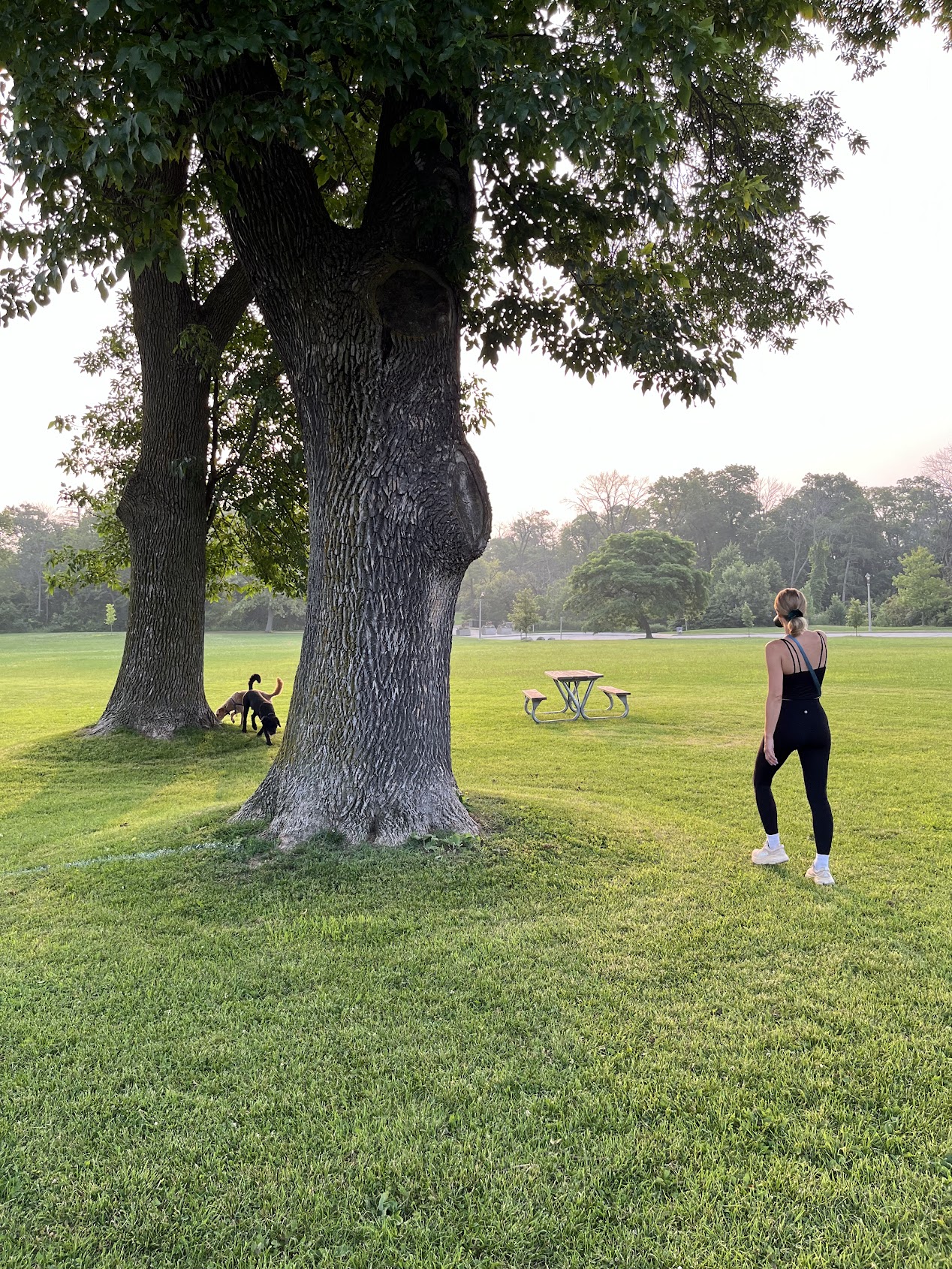
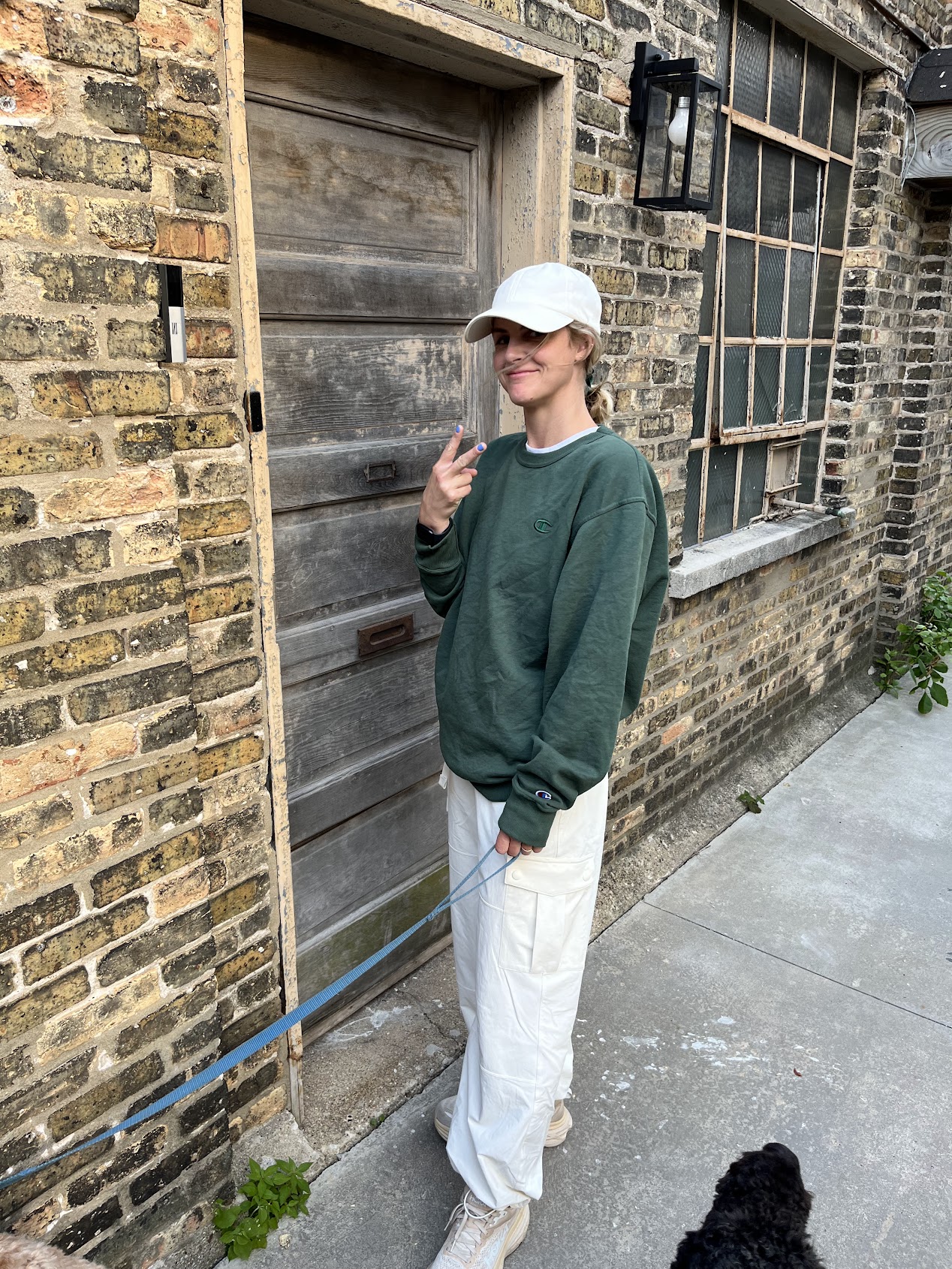
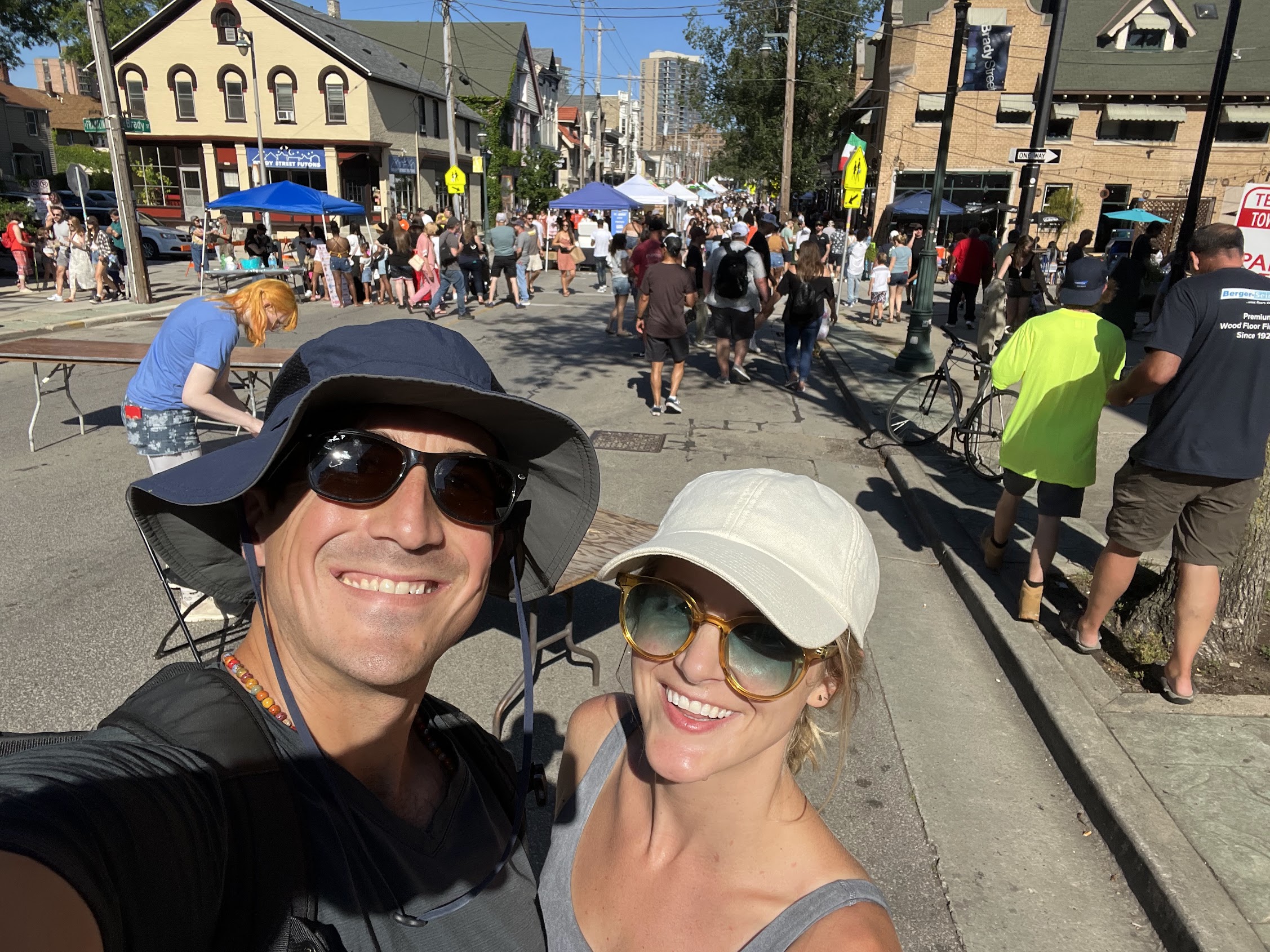
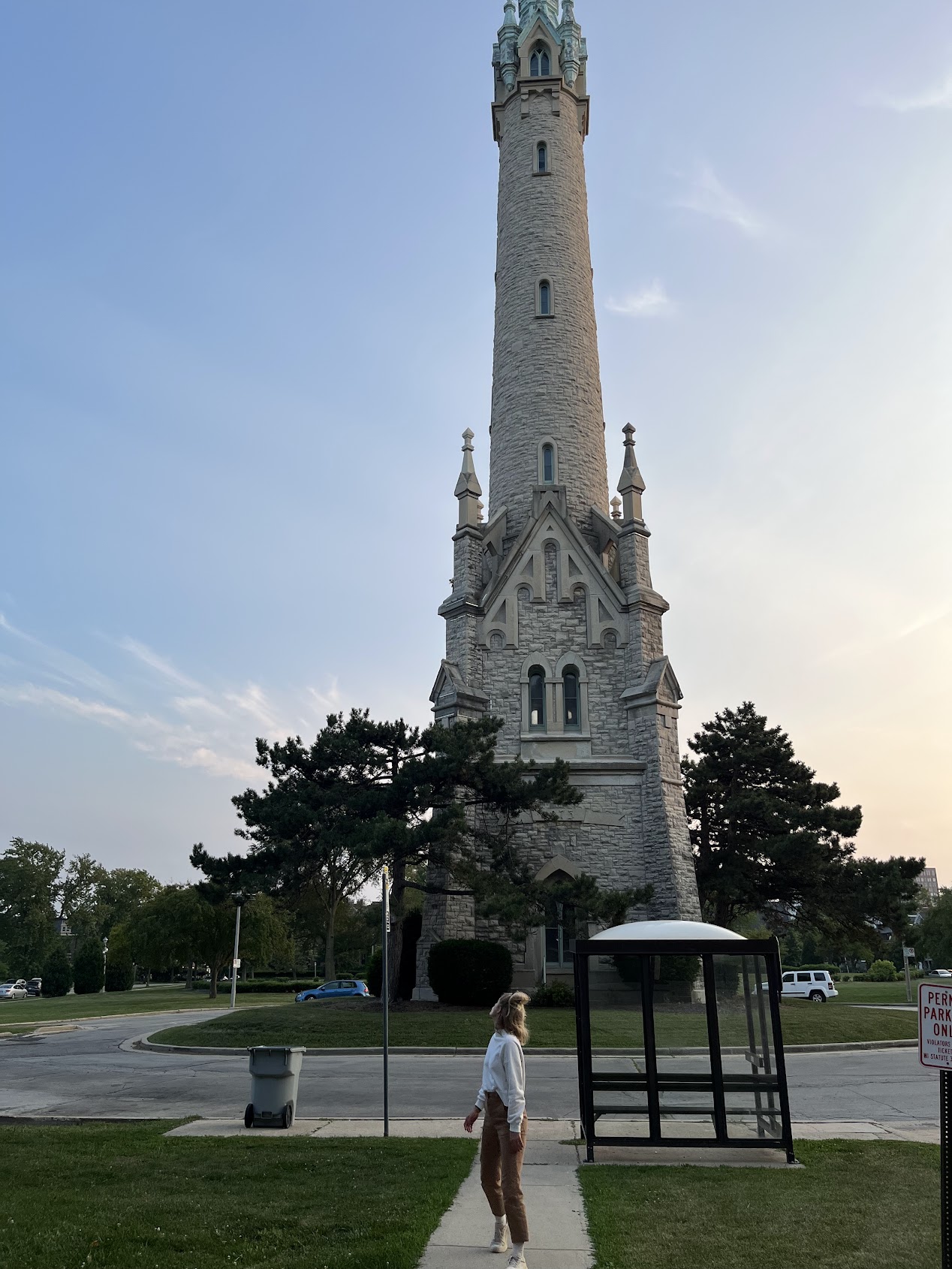
Lake walk in Bay ViewWith the Mertens, on a lake walk in Bay View. Can you tell how we like to spend our time?Boys day! Walking around the new hood with my Milwaukee tour guide, Kevin. Morning walks at Lake Park The apartmentBrady street festival A cool old lighthouse
You show up to live with a foster family at age 12. You’re traumatized from the freshest round of sadistic abuse your biological mom recently inflicted on you, but at least that’s over. You’re hoping for a respite, for some tenderness, for some love. You are instead greeted with coldness and a set of strict house rules. You do the dishes for the family of 8 after every meal. You are told you will be skipping school the next morning to help your new foster dad on outdoor construction sites. You will not be paid.
You are led down to a dingy basement that you share with four other foster kids, including a special needs infant that is not getting the attention it needs. The door is locked behind you. No one is allowed to come up until the following morning. You empty out your garbage bag of belongings and climb into your bed. You try to appreciate the fact that at least you got to walk down the stairs to this dungeon. Your last trip down a set of stairs was when you were sent tumbling after your mom kicked you down a flight at your apartment complex. That bloody adventure is what finally got child protective services to remove you from her care. You close your eyes and try to sleep through the babies cries.
***
Your first memories are of being a toddler and feeling the sharp pain of a wooden spoon whacking your head. You cry, whack. You try to sit at a table not designated for foster kids, whack. You try to stop your foster mom from hitting your sibling, whack. You don’t like the food on offer? Whack, whack, whack. When your mom is feeling extra medieval you’re hung up by your collar on a door hanger for a while. Complain about that, more whacks from the spoon. You are given no parental love and no hope that anything will ever be different.
***
You are 14. You wake up one day to learn that your unstable, violent mother has left. For good. You have 5 younger siblings to look after and an apartment to manage. You are scared to tell anyone what’s happening because you fear being separated from your siblings. You steal to get by and somehow make the whole thing work for 6 months, until your power and water are cut off.
***
Those are just a few of the horror-movie scenarios you’ll read about if you go to the library and pick up every book you see about foster care. I’ve learned about parents who prostituted their pre-teen daughters, or pulled out every one of their child’s teeth as soon as they grew in, or scalded their baby before killing it. One teenage girl talked about how her infant brother starved to death because, “There was nothing to eat but jam.”
Excuse the analogy, but peering into the shadows of the foster care system reminds me of the first time I watched undercover videos of animals on factory farms. Before seeing the videos, I knew somewhere deep down that many farm animals were being mistreated. But it’s still a gut punch to watch and listen as a barn full of pigs are killed via ventilation shutdown, which suffocates them over a period of hours.
In the same way, I knew lots of kids were suffering and needed help, but it’s still a gut punch to read first hand accounts of the kind of abuse that goes on both with biological parents and in foster care.
Thankfully, there is also a lot of beauty and hope in these books. There are tough as nails kids who persevere through unbelievable hardship, and parents with huge hearts who do their very best to provide love to people who have felt far too little of it. There are also social workers going above and beyond to help families, despite extremely long odds their efforts will make any difference.
Of all the books I got, four in particular stood out to me:
One from the point of view of someone who was in the foster care system and was eventually adopted — A Place Called Home, by David Ambroz
One from the view of a person who worked as a social worker, helping with foster kids and parents, as well as adoption placements — The Children Money can Buy, by Anne Moody
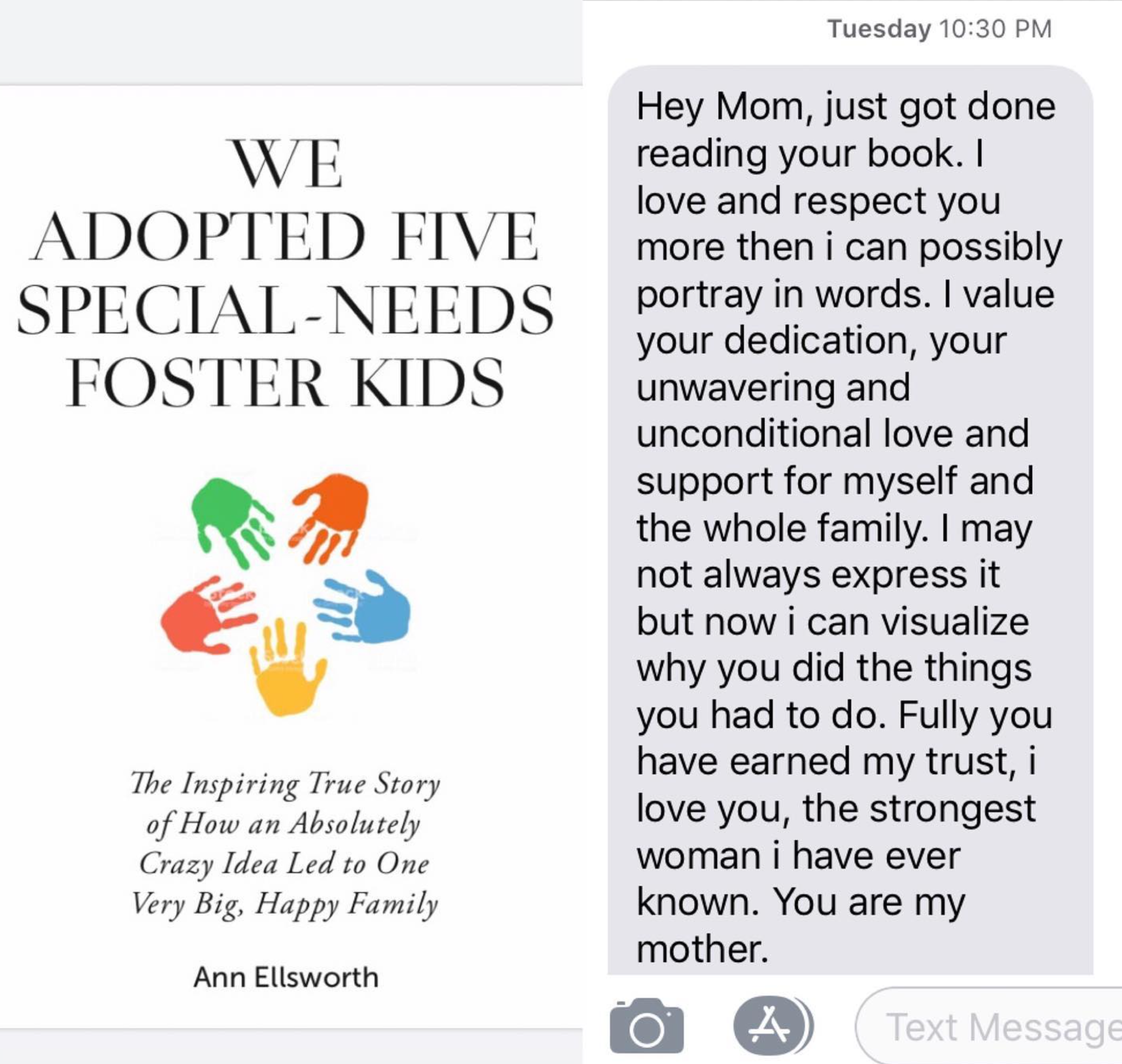
One from a parent who adopted five special needs kids out of the foster care system — Whelmed, by Ann Ellsworth.
One from a teacher, professor, and foster parent who studied the foster system over the course of a decade in the early mid 2000’s — To the End of June, by Cris Beam.
I came away with several broad takeaways.
Some foster parents are in it for the money
All the books highlight parents that are doing foster care or adoption for all the wrong reasons. The bad families appear to see the kids as paychecks.
We rarely get to hear from those parents directly, but their actions speak louder than words. And the kids are on to them. A girl from To the End of June, Lei, who had recently beaten the odds and left her foster family for college, was not naive about her situation:
Lei had only one picture of her foster family, and she dutifully pointed out each child, and the mom, as though she were naming employees at a job she once held a long time ago. Said Lei, “When I left her house, the mom never bothered to call. I felt like, ‘Screw you, man. I’m ready for my life.’ I felt like she did it for the money. What can I feel?”
David Amborz, from A Place Called Home, stayed with a family that forced him to stay home from school and work as an unpaid manual laborer. He also acted as an infant caretaker and maid.
One of the more disturbing tales comes from The Children Money Can Buy. The author, Anne Moody, had to do a home visit to see a foster baby who lived with a woman who was considered a cream of the crop foster parent. She lived in a beautiful, large home and in the past had won a “Foster Parent of the Year” award.
One day Moody went to check up on one of the kids. The foster mom said the baby was sleeping. But when she went into the room to check, the baby (14 months) was wide awake.
She was sitting quietly in her crib and paid little attention to us as we entered the room. There was no crying — but there was also no sign of greeting or expectation. She did not jump to her feet, lift her arms to be picked up, or make a single sound. It was eerie.
Moody reported this woman, and after subsequent investigations it turned out that this supposedly model parent was essentially imprisoning the babies to their cribs at all times of the day. She eventually lost her foster care license but faced no other repercussions.
The incentives to foster and adopt are not good enough
Society has no issue advocating for higher pay and more benefits for teachers, first responders, nurses, and other jobs where people help the most vulnerable for the greater good. Why should foster parenting be any different?
To the end of June highlights a foster parent advocating for more pay:
Bruce Green, who has brought several foster kids into his home on DeKalb in addition to baby Allen, doesn’t see anything wrong with treating forster parenting as job. “You have people who have been foster parenting for years, and there’s no health insurance, no life insurance, and if they stop, there’s no retirement,’ he said. Bruce riled at the notion that giving parents more money and benefits would yield a more selfish crop of applicants. “There should be incentives to being a foster parent; there should be deals with cable, lights, and water. Being a foster parent should be something that’s earned.”
By earned, I think he means the job of being a foster parent is so desirable that people are meeting a high bar in order to qualify. That’s something I can get behind.
My paycheck takes huge swaths of money out and sends it social security and medicare. I am all about taking care of the elderly, but maybe we need a big pool of money for all these struggling kiddos, too?
I know this is pie in the sky thinking. I have done zero investigation into the feasibility of any of this. I just know I’d be perfectly happy to give half us much as I am to medicare and have the other half go to some sort of abused children fund. The problem seems that big and important. And in general, though this might sound callous, I value helping people with a lot of life left to live.
The economic argument for helping these kids is that they’ll have much less problems later in life. And these kids cause very expensive, emotionally devastating, society-wide problems. To the End of June puts it like this:
It’s been said that the economic impact of child welfare reaches upwards of 100 billion — in adult criminality, mental illness, homelessness, and so on — and this backsplash is traditionally pegged to the structural failings of a battered system.
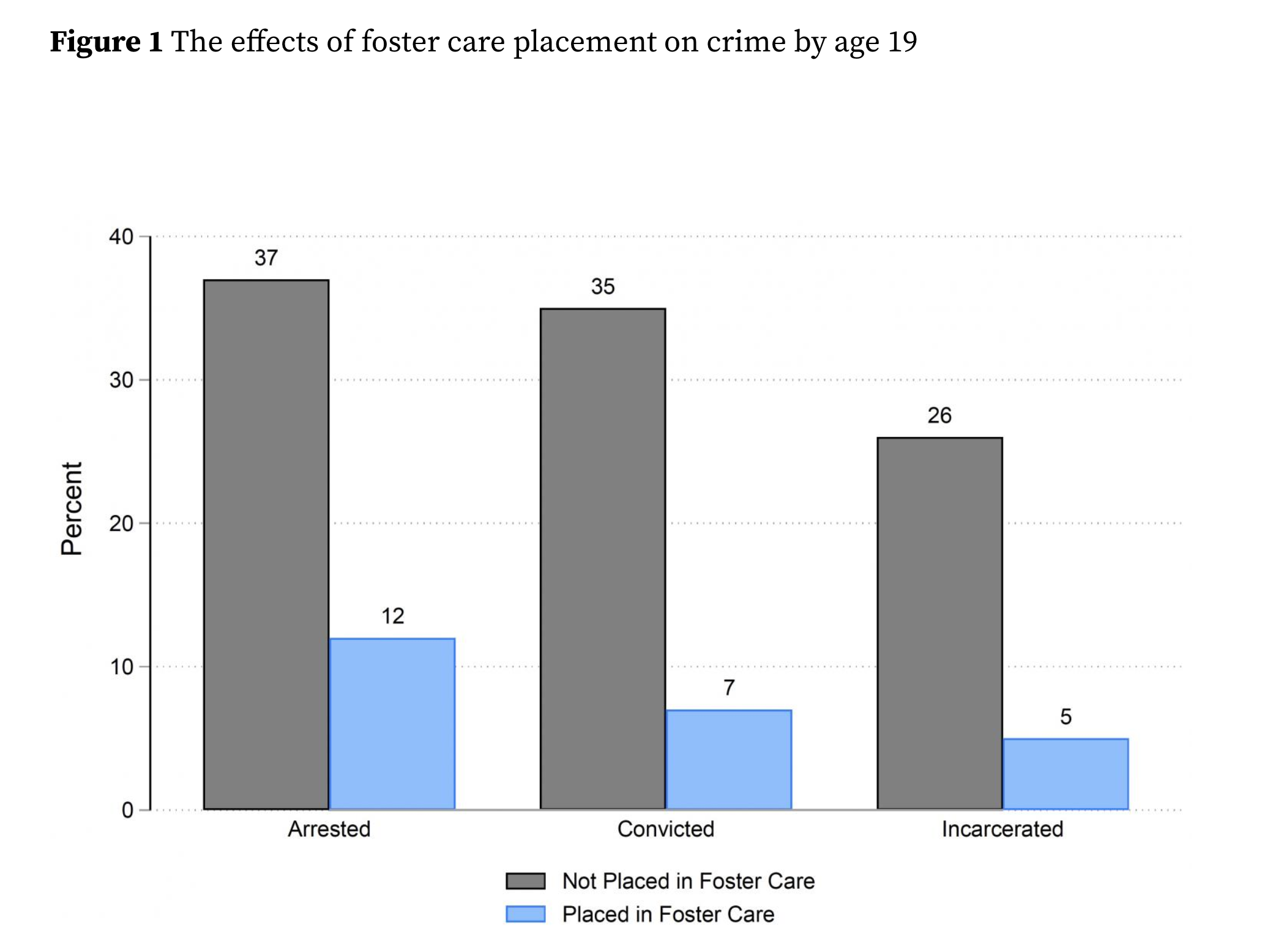
The criminality aspect is especially disturbing. Recent estimates are that 1/5 of the adult prison population is former foster children and almost 70% of kids who age out of the foster system are arrested by the time they turn 26. Equally sad is the fact that, according to estimates from To the End of June, 25-50% of all homeless people were in foster care at one point.
We compare the outcomes of children who by chance are assigned a strict investigator and placed in foster care to the outcomes of children who are assigned a more lenient investigator and are not placed.
The study finds that foster care placement reduced later-in-life crime
If you study specifically a subset of kids in harsh situations who could be left at home or placed in foster care, the system looks better.
Still, even though foster care is often the least bad option for kids, it can still be quite bad. David Ambroz comes up with a few different ways the system can be improved. They seem reasonable to me. His main wishes:
Decrease caseloads and increasing pay and benefits of social workers.
Incentivize wealthier parents to foster. “Perhaps above all, we need to recruit more middle and upper-income foster parents with higher education degrees. This effort is not to displace but to add to and diversify the incredible commitment of lower economic classes who are already fostering.”
Make foster parents eligible for pensions, give them free health care, and give the foster kids and any of their biological kids free college tuition
Let older foster kids enroll in community colleges as well as high school in order to do vocational training
Provide priority housing for foster youth at community colleges
Put more effort into broad, society wide poverty fighting efforts
Providing more money and benefits to foster parents would be controversial, for sure. Some people think doing so will attract the kind of person, who is just in it for the money. My take is that those people already exist, and at least if the incentives were better some more upstanding people could crowd out the less savory ones. Whatever we’re doing now is not working.
We should run more experiments where we provide better resources to foster parents and kids
There have been small-scale experiments where foster parents and kids are given more than the standard amount of money and resources. There was one in Oregon and Washington where parents were paid $100 more per month than regular foster parents and overall the children were allotted 60% more funding than normal. Also, the caseworkers working with them had significantly lighter loads than normal. The results are promising.
From To the End of June:
The nearly five hundred kids in the study had entered foster care as adolescents between 1989 and 1998 and were evaluated in the early 2000s. The Casey kids, now adults, had experienced less than half the rate of depression and substance use, and about 70 percent the rate of bolic disorders. They also endured significantly fewer ulcers and cardiometabolic disorders. The authors, who were headed up by a team at Harvard, claimed that this was the first ever study to look at the long-term effects of enhanced, or more thoroughly funded and supported, foster care.
That’s all great! Sadly, I dug into that study, and the outcomes are not quite as rosy as the author makes it seem. She doesn’t talk about how despite the extra effort and money, 4/5 of the foster kids enrolled still faced “significant challenges in the areas of mental health, education, and employment and finances.”
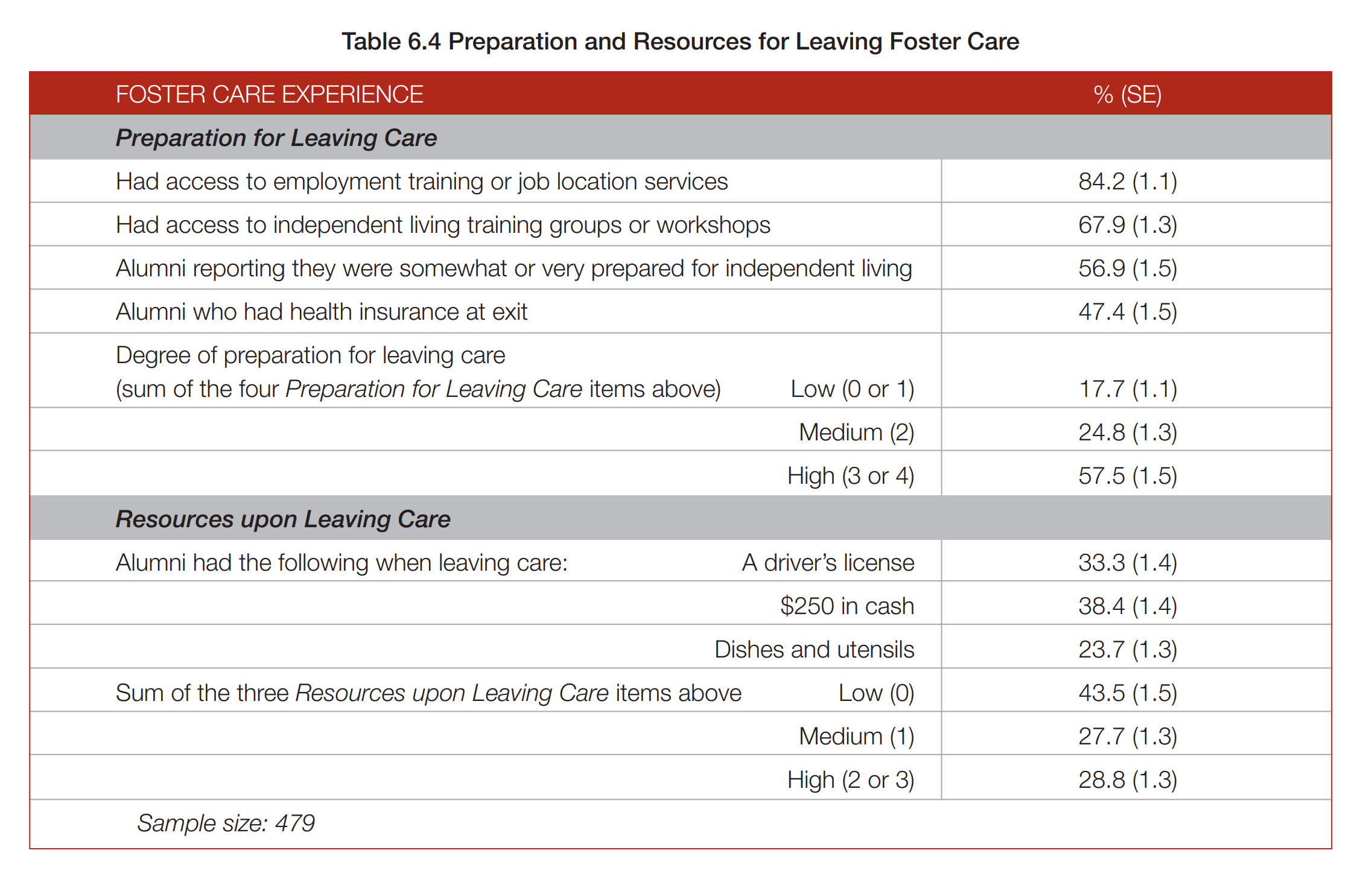
They still barely had any money when leaving care, and a high percentage of them were not prepared to take care of themselves. Most did not have health insurance, and only 38% had $250 in cash to their names.
This is not to knock the experiment. I’m glad they tried it. In my dream world we would try this again, but with ten times the money and services provided.
Maybe we should invest in these vulnerable and traumatized kids similar to how we do for vulnerable and traumatized veterans and see where that gets us.
The question of how and when to remove kids from abusive homes is more complicated than I realized
In The Children Money Can Buy, Anne Moody talks a lot about her personal experience doing home visits. She was a social worker for the state of Michigan, and she had some really harrowing experiences. One of her first home visits was to the apartment of a mother who was in the process of trying to regain custody of her young kids after losing it.
She showed up to a filthy apartment and decided she had to take the 8 year old daughter, Missy, to the hospital. “Her eczema was so severe that she had clawed bloody wounds into her hands and arms. The poor child had no medicine to relieve the itching, and it was obvious the skin was now infected.”
While that is sad, Moody talks about how it’s not her remove kids from their parents care unless the situation is truly dire.
What counts as truly dire comes down to a judgment call, often made by a stressed out and overworked early 20-something social worker. While neglect is a reason to rescue a child, determining what counts as neglect that crosses the line is hard. Here’s Moody talking more about how, in her eyes, there was nothing she could do for Missy:
Despite the risk to her children, Missy’s mother’s inadequacy in this area didn’t constitute grounds for permanently removing them from her care. She couldn’t be compelled to upgrade her standards and she wasn’t amenable to encouragement, particularly since she didn’t even recognize that there was a problem in the way she cared for her children — or herself. She wasn’t at all interested in my explanations about how to tend to her daughter’s wounds, but she did think it was nice that I had taken Missy on a four-hour outing. Not long after the visit, the mother regained full custody, and her children were removed from my caseload.
There are a lot of people that think most kids are better off with their parents than in the state’s custody. They think that we are too quick to remove kids from parents who hit a rough patch and just need a little support. They make some compelling points. And the disastrous state of the foster care system is hard to argue with. This stuff is so, so hard.
David Ambroz represents the other side of the coin. He comes across as someone who would advocate that social services step in sooner in a lot of cases. You can tell why after reading his book.
He had to watch in silent horror, multiple times, as social workers investigated his birth family’s living conditions . He hoped beyond hope someone would remove him from the hell he was in, but his mom was always able to trick the workers into believing they’d just hit a rough patch and everything was fine.
When the children’s input was sought by the child protection services workers, it was always in front of the mom. The kids were put in the brutal position. Tell the truth, and possibly be rescued, but face certain and painful wrath from the mother if the workers left him there. Or lie, say things weren’t that bad, and watch as yet another opportunity for help slips their your grasp. That’s a very heavy burden to place on a child.
Ann Ellsworth also ran into much infuriating red tape when trying to adopt children from the foster care system. The first two kids she adopted told her all about the litany of abuses they suffered at the hands of their previous foster mom, Ms. Smith.
Ellsworth could not live with the thought of her kid’s siblings still living in that environment, so she set out to adopt them as well. She was stonewalled for months even after reporting horrific abuses. She was only able to secure approval to adopt after she directly “befriended” Ms. Smith and got her to agree to give up the kids.
As Anne Moody points out, the number one things CPS workers are trained to do is reunite families. And once they’ve made a placement, they want it to stay that way. Whether that’s because moving kids takes thankless work, or they genuinely believe stability is always more important than escaping some abuse, is hard to say.
A woman profiled in To the End of June represents the extreme end of the ‘keep families together at all costs’ camp. The author describes seeing this person, a top executive in the NYC social worker world, give a talk about her strong desire to keep families united. The author Beam notes that,“In all her years, working her way up from a case manager to a director overseeing 250 employees, Dr. Rittner terminated parental rights only four times.”
When the author later relays this story to a teenager in foster care, the foster youth, Arelis, is incredulous:
“For you to oversee a thousand cases and only terminate four, you’re doing something wrong!” She slammed her hands on the table and gazed up at the ceiling in exasperation. “Did the people in the meeting call that lady out? Did they think she was doing her job?” Arelis, who generally speaks softly and with a slight lisp, raised her voice again and then had to get up for a cigarette. On her way out, she fumed, “Less than half the parents could get better if you gave them the right help. Did they have a former foster child there to speak for us?”
Arelis and her 5 siblings had been sadistically abused and were removed from their mother once, only to be placed back in her care. Then the mother abandoned them. Arelis, at age 14, watched over her 5 younger siblings as a solo “parent” for 6 months at one point. She thinks her mother’s rights should have been terminated the first time around so they could have received the help they needed.
The foster care system as a whole is not performing well
Something is deeply broken in the system. To the end of June cites a study showing the extent of the issues, as of the early 2010’s:
Federal investigators recently spent three years looking into seven fundamental criteria for successful foster care in all 50 states. They examined the basics: things like kids being protected from abuse and neglect, being safely maintained at home whenever possible, and receiving adequate services for educational and physical health needs. No state met more than two of the seven criteria.
Grades like that should require drastic changes. The fact that they don’t makes clear the depressing reality that we just don’t care that much.
Attachment is way more important than I realized, and it may never happen between foster kids and their parents
All four books deal with the importance of a child attaching to their parent. I didn’t come away with a clear idea of what attachment exactly meant, or how you can be sure it’s been achieved. I did gather that the longer one goes without having healthy attachments, the harder they become to form. Without healthy attachments, a kid is at higher risk of developing issues that make it hard for them to successfully function in adult society.
Attachment is seen as the key thing that needs to happen for a child, and a family, to be healthy. Yet so many of these kid’s lives were so messed up and disrupted that it’s hard for them to trust or bond with people.
One of the hard lessons Ann Ellsworth had to learn was that no matter how hard one tries, it may never happen. You ultimately have to remember that there are only so many things you can control, and a lack of attachment does not mean you are not a loving parent.
Making matters tougher is the fact that attachments to toxic birth mothers hinder a lot of kids. David Ambroz was clearly worse off in a lot of ways for having been so attached to his mom. He often lied to social workers about what was happening to him to protect her. It’s a common problem that a lot of kids face.
We need a science for how to de-attach and then healthily re-attach.
Absolute selflessness (and a lot of money) can help make fostering and adoption go well
Ann Ellsworth and her husband didn’t hope for kids who would shower them in love and gratitude. They simply wanted to help the kids be able to function in society. In the end, they got there. But only after an unbelievable amount of timeouts, physical restraining, home schooling, live-in tutors (they cycled through almost 30), counselors, psychiatrists, and general patience.
This ties back to the whole foster parents need more money to do well thing. I don’t know the Ellsworth’s exact financial situation, but when they moved out of NYC they bought a house she describes like this: “It was a 4,300 square foot brownstone on a former Air Force base overlooking Lake Champlain. It was enormous, with eight bedrooms and three floors that had sightlines across the parade field and the lake towards Vermont.”
I am going to go out on a limb and say most foster parents can’t afford mansions on a lake.
But even with the money and resources, it was an absolute slog to help their kids become stable, non-violent people. You’ve gotta be ready to put in serious work. This passage gives a good sense of the constant drama the Ellsworth’s were dealing with, and the way they met those challenges with determination. Long quote incoming, but I think it paints a nice picture of the stress of dealing with traumatized and violent children:
Two weeks in, Jason was no longer welcome in gym class either. Another week passed and he was pulled out of structured reading and library time as well. I spent more time driving him to and from school than he spent in the classroom and still, I cherished the moments he was out of the house. Another week passed and he was home for good. The principal called. “I have never known a more deceptive, manipulative child than Jason. Get him out of here. This was coming from someone who had worked with a lot of deceptive, manipulative children. It was terrible news yet strangely validating.
Ruby returned to middle school for core classes only. She was not allowed to have a locked and had no unsupervised access to other students. In the three minutes between bells, she had to check in with her guidance counselor and and came home every day for lunch. We were very clear with Ruby, “Engage another child physically and we will pull you back out of school.” A month into her modified program, Ruby punched two of her classmates in the face during math class. I met her in the principal’s office. Even her telling of her side of the story was damning and calculated.
After these failed attempts, I was forced to accept homeschooling as my new calling and took up the mantle of educator.
That woman is tough.
Imposing very restrictive house rules is a socially acceptable (and encouraged!) way of dealing with violent children
In Whelmed, there was a lot of isolating one kid from the others, putting them in physical restraints, and locking them in rooms. In the wrong hands this method feels like it could go very south. But when done with incredible patience and infused with constant affirmations of love, it can work wonders.
It felt like at least twenty times, Ann Ellsworth said something like, “I restrained Susie as she thrashed and hit me, chipping one of my teeth and bruising my chin. I held her down for 30 minutes until she finally relented. Then she went for a timeout.”
It seems like half this woman’s parenting life was spent on physical restraints and then timeouts. Apparently that is totally acceptable protocol for dealing with traumatized and violent kids. You are supposed to be strict, maintain control, not let their behavior escalate, and be extremely tough. Timeout often meant putting the kid in a windowless room and holding the door shut while the kid pounded on it and cried.
I was left wondering if there are any other recommendations. Ellsworth talked a few times about people suggesting she medicate her kids, but she never wanted to. The one time she tried Ritalin on one of them it only made things worse. The hardest stuff she ever gave them was Benadryl.
Amazingly, she didn’t even legally sedate them with TV or electronics. Maybe if you aren’t going to give them iPads and you aren’t going to give them drugs, you’ve got to master your MMA style takedowns and hope for the best.
I am amazed they had the energy to do it all over the years. But I bet it felt good to get this text from one of her kids after her book was published.
My heart goes out to all the kids in need and to those trying to help them
There are so many kids in the US in unfortunate situations. Here’s another figure from the Casey Family Foster Care study:
Almost 1/2 of the kids in foster care have been sexually abused!
It’s easy to be cynical when you look at numbers like that, or if you dig into any number of troubling aspects of the foster care system. I don’t blame anyone for finding it easier to just not think about it. The problem is deep rooted and would take institutional upheaval to solve, so why try?
That’s why I am inspired by everyone doing even little things to make these kid’s lives incrementally better, despite the odds.
Those folks reminded of the boy from the famous starfish story. I like this adaptation:
One day a man was walking along the beach when he noticed a boy picking something up and gently throwing it into the ocean. Approaching the boy, he asked, “What are you doing?” The youth replied, “Throwing starfish back into the ocean. The surf is up and the tide is going out. If I don’t throw them back, they’ll die.” “Son,” the man said, “don’t you realize there are miles and miles of beach and hundreds of starfish? You can’t make a difference!”
After listening politely, the boy bent down, picked up another starfish, and threw it back into the surf. Then, smiling at the man, he said…” I made a difference for that one.”
I hope to make that kind of difference for a kid someday.
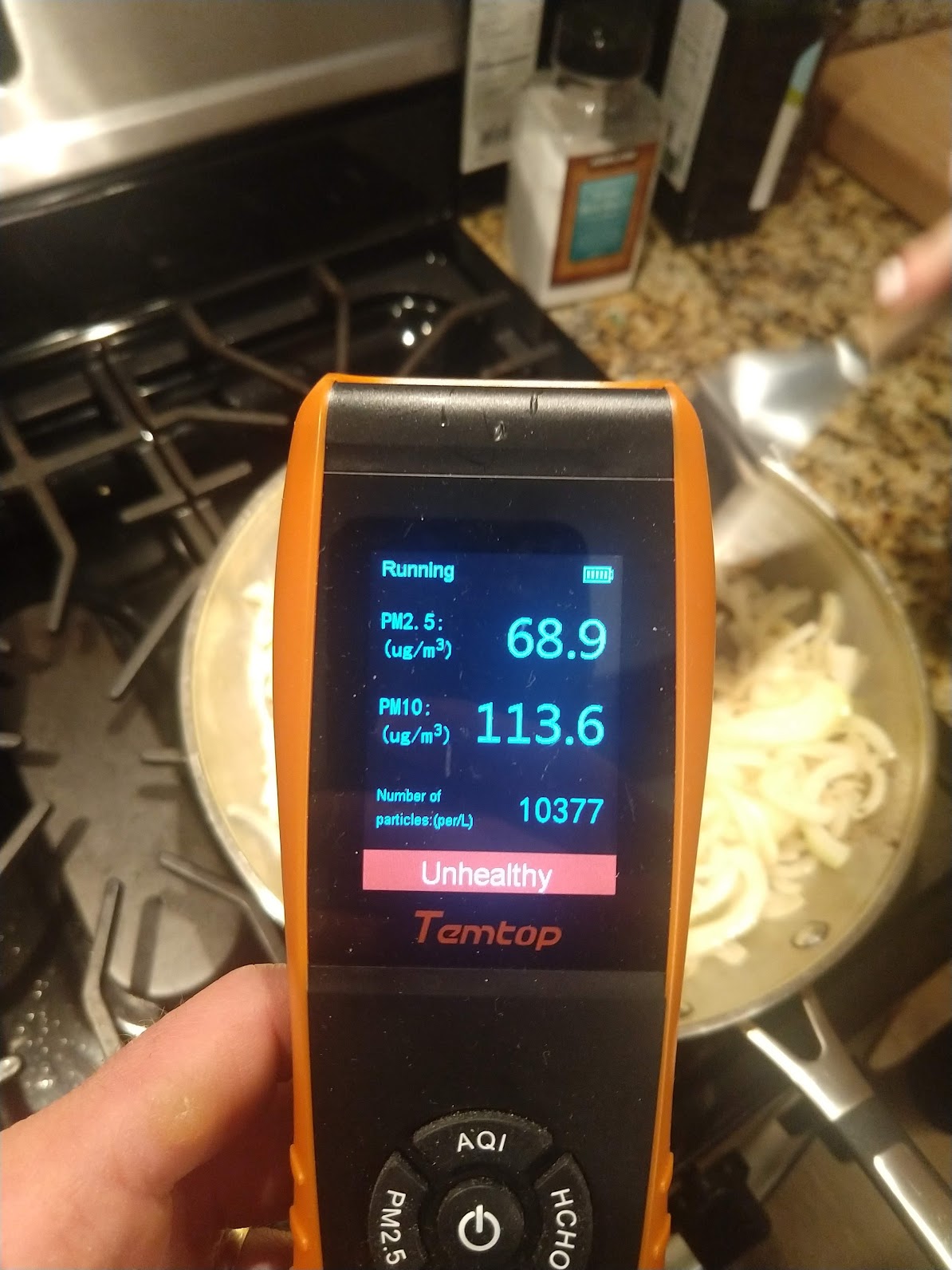
Taking my life into my own hands by sautéing onions
The device gives measurements for particles of 2.5 nanometers in length (PM2.5), particles of 10 nanometers in length (PM10), volatile organic compounds (VOCs), and a number for the air quality index, or AQI (which is entirely based on the level of 2.5 nanometer particles present as far as I can tell.)
I’ve had fun messing around with it to both optimize my indoor air quality and to see how polluted different places are.
The problem
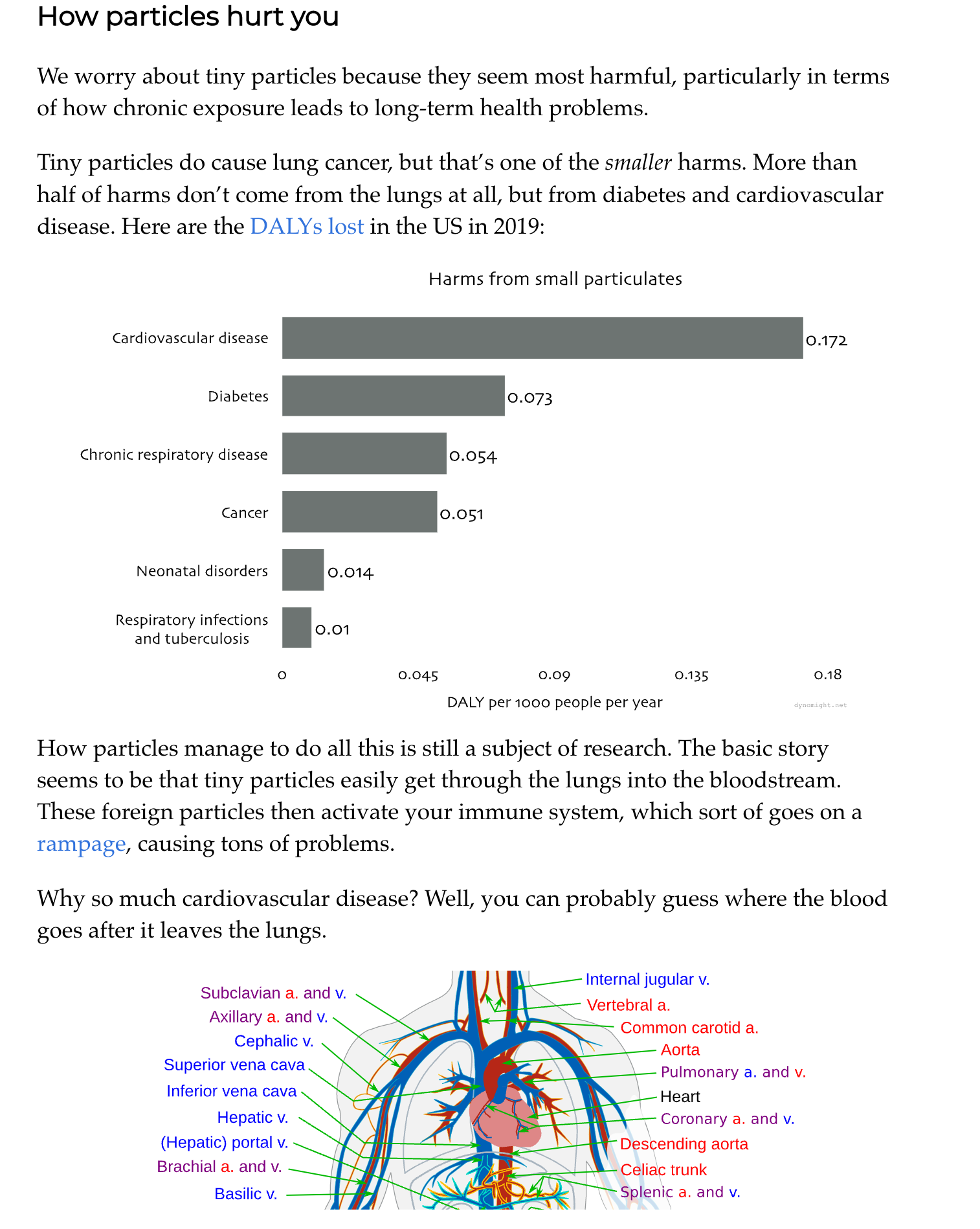
If you are consistently exposed to lots of fine particles in the air, you get lung and heart problems.
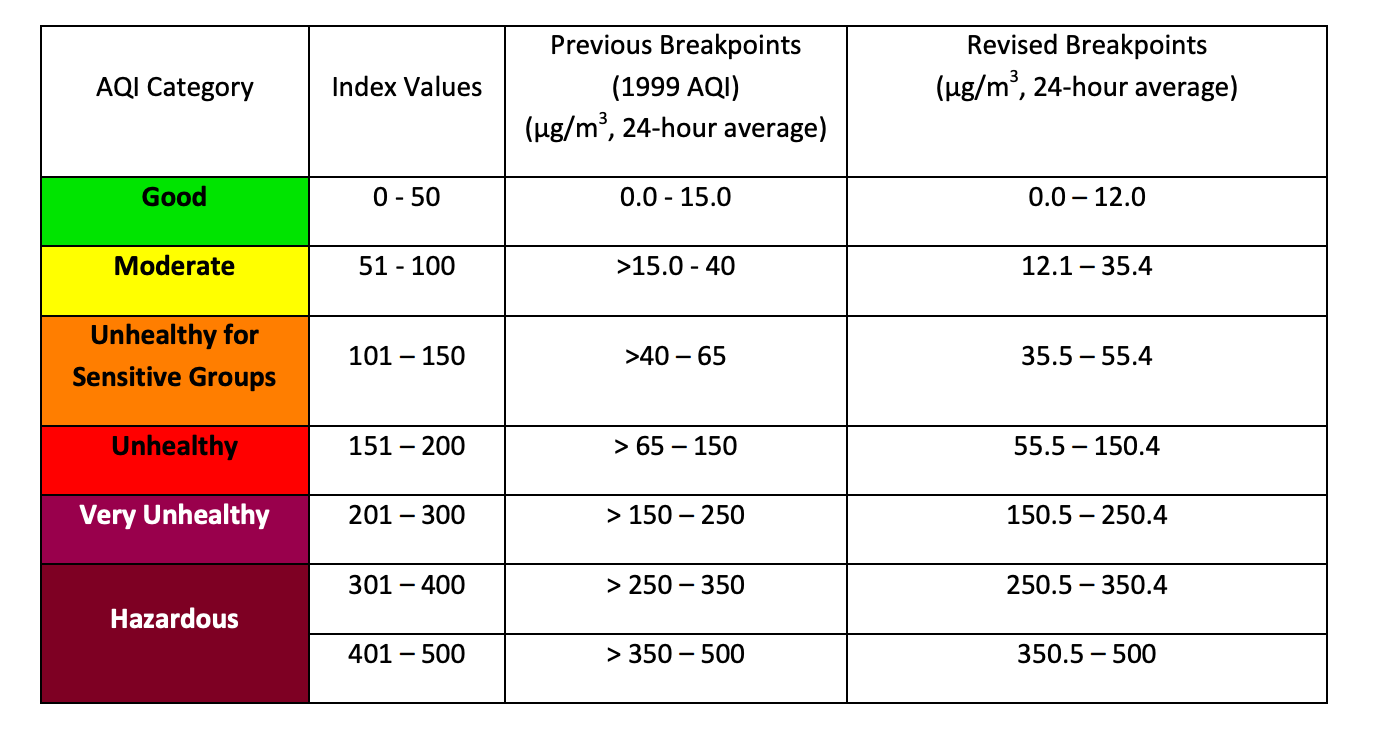
According to the EPA, a PM 2.5 level of 12 is the upper limit for healthy air. If an area is at an average of a 12 over a 3 year period, they are healthy by EPA standards.
Dynomight says you really want the PM 2.5’s to be at an average of 5 or below to prevent health problems. I haven’t done my own research here. I use the 5 or below upper limit in my home.
It’s a pernicious problem because you can’t tell a difference between healthy and harmful levels. At least, I can’t. I only notice something’s up when it’s obviously smoky in a room. I wonder how many people have no idea they are inhaling PM2.5’s in the 15-40 range every day of their lives. Then they have heart and lung problems at 65, and assume it’s only because of bad luck.
Here is a screenshot from Dynomight summarizing the problem with small particles:
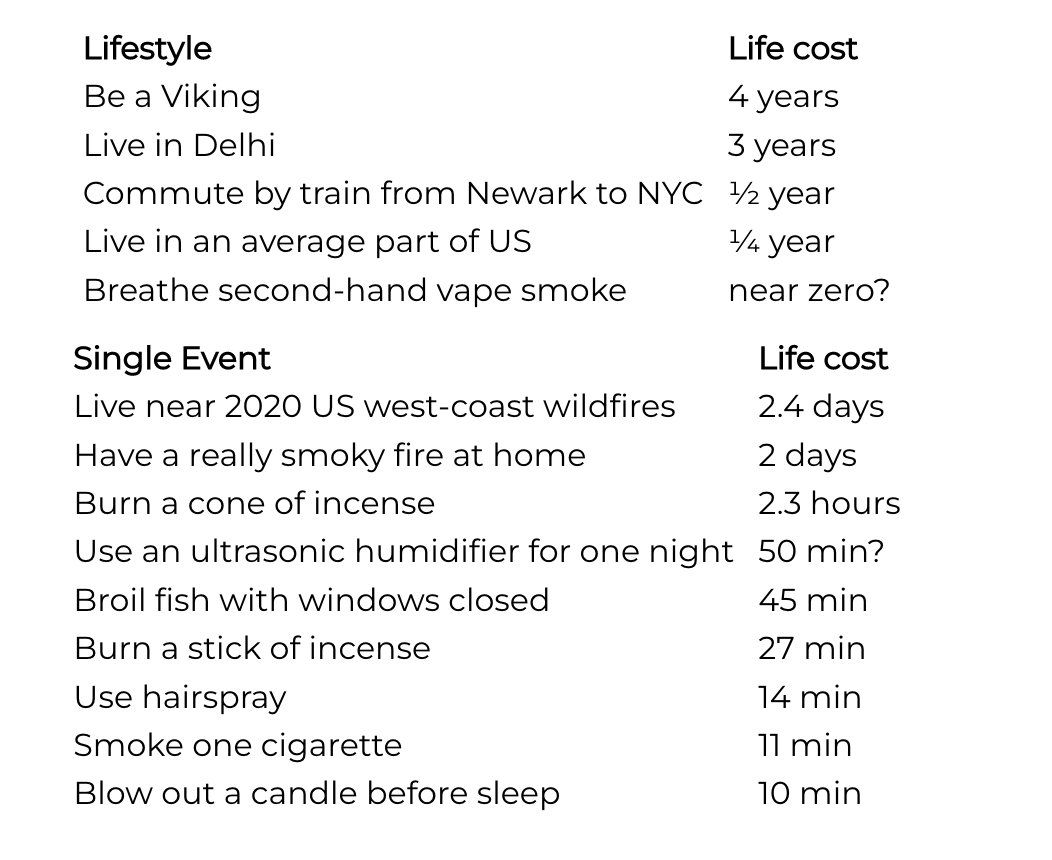
One calculation from that post particularly stood out to me. It refers to how particles shorten life expectancy (A DALY is a disability adjusted life year, or the loss of one year of full health)
A life-long exposure of 33.3 PM2.5 costs 1 DALY […] Moving from somewhere with no particulates to somewhere with a level of 100 costs 3 DALY.
How I clean my air
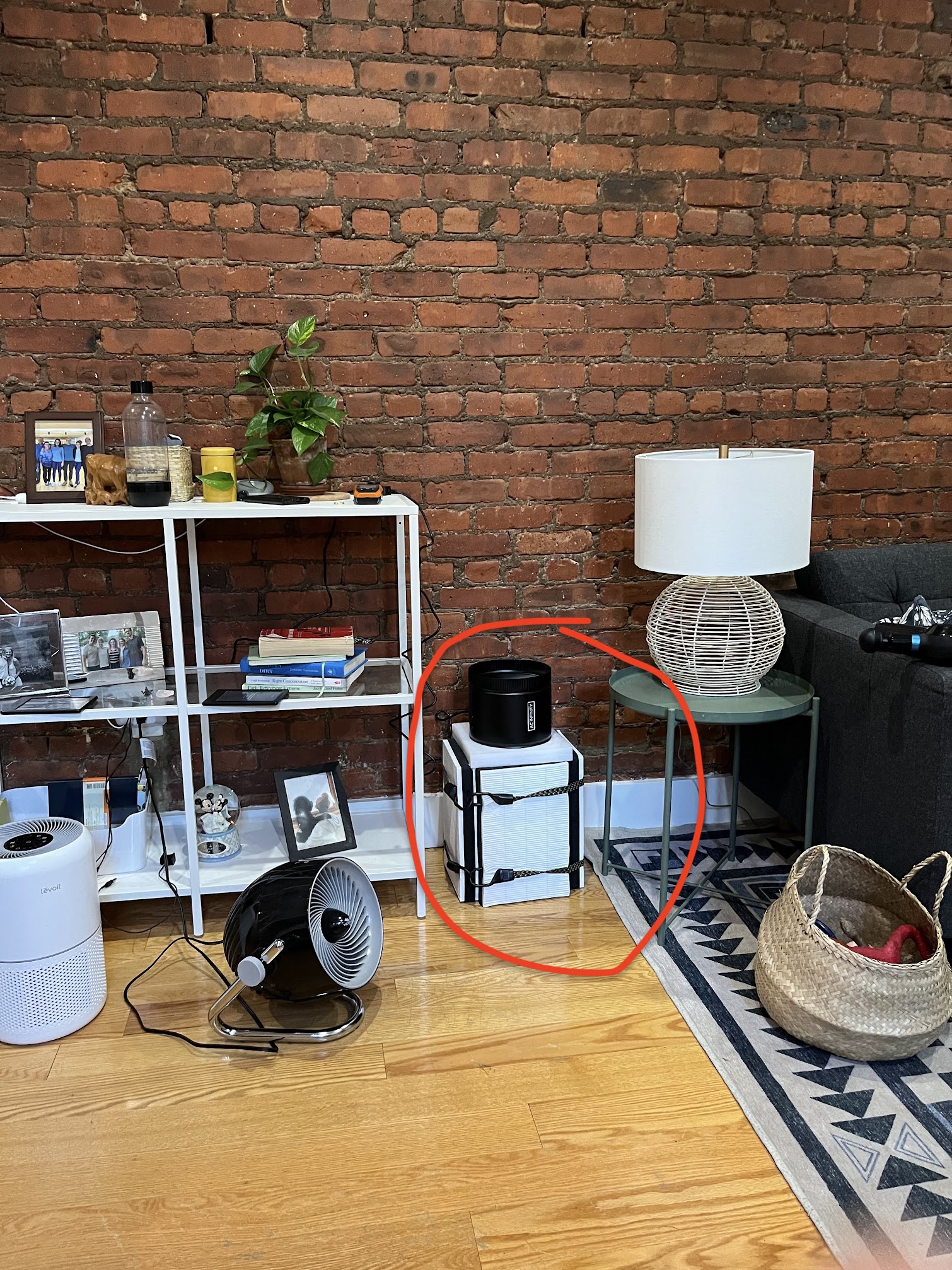
I have a cuboid, of course! It’s a beast-mode homemade filter unit that costs way less than a comparably powerful unit you can buy pre-made. You lose a lot in the aesthetics department though, so if that’s an issue you gotta pay up.
I also have a three other filters, two in the bedroom and one downstairs in my office. Two of them are small Levoit’s and one is a midsize from Coway. I bought those before I’d seen the cuboid light. They work pretty well, but they are expensive. You can also make cheap and effective filters using box fans, but they are noisy.
NYC can produce some serious pollution. The AQI outside is often between 50-100, which means PM2.5 levels between 12 and 35. When it’s like that, our indoor levels will creep up quickly if we have a window open and no filters running. With our system, PM 2.5 levels stay consistently at 5 or below.
The EPAs revised safe levels as of 2012
Things that make my air pollution detector go wild
Once you start playing around with the air quality monitor, you realize that evil particles are all around you and constantly trying to kill you. Mostly when you are frying things, or when you leave the window open for too long in the busiest city in the country.
Pan frying buckwheat pancakes
Pan frying just about anything, including just vegetables, throws off some scary numbers.
But Buckwheat is king. Once they get smoking, ol’ TemTop acts like I am standing next to a burning paint factory. Within seconds it cycles from “unhealthy for sensitive groups” to “unhealthy” to “hazardous”. It maxes out the machine and does everything but alert the paramedics.
Buckwheat pancakes are amazing though, it’s all worth it.
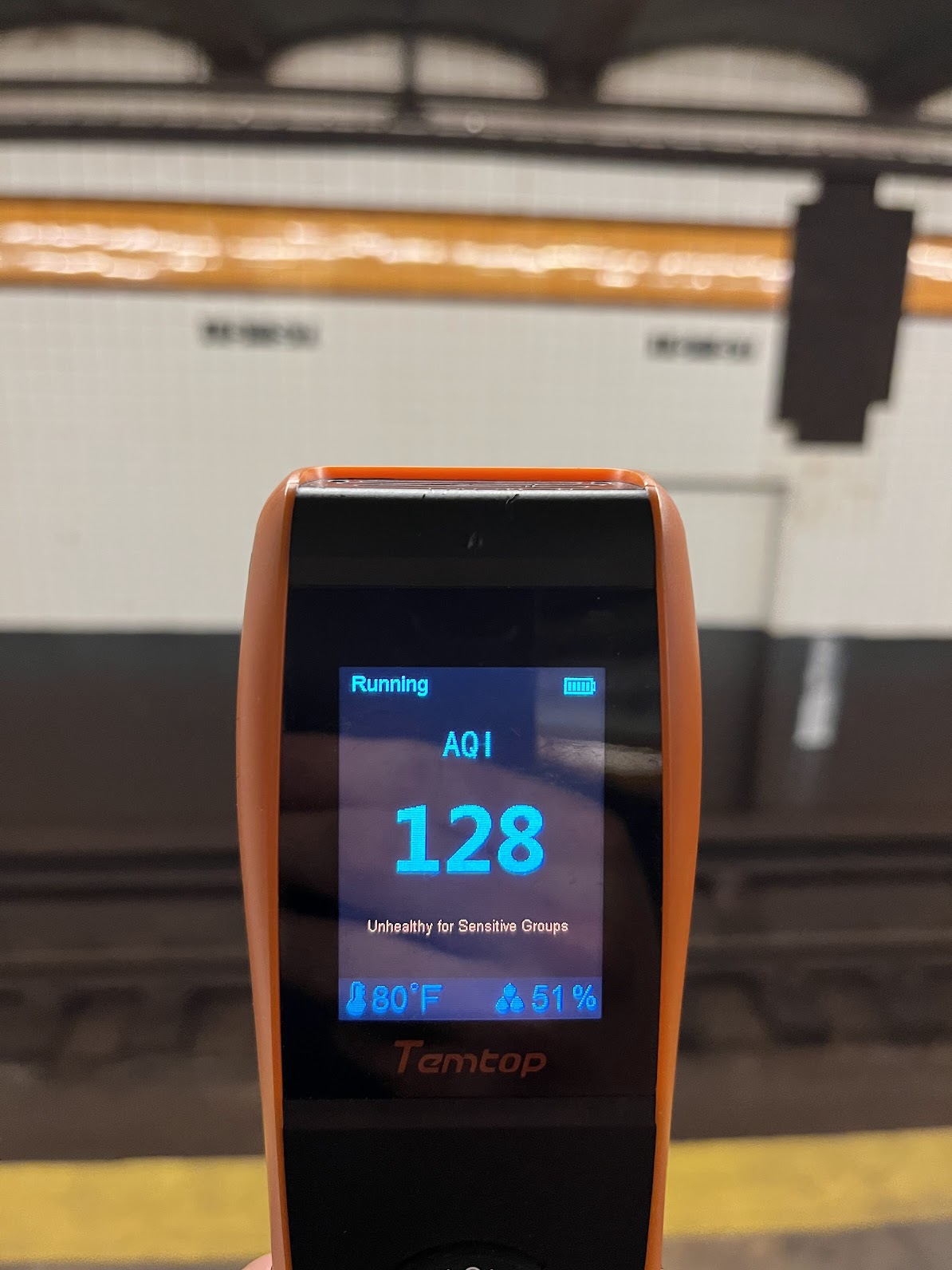
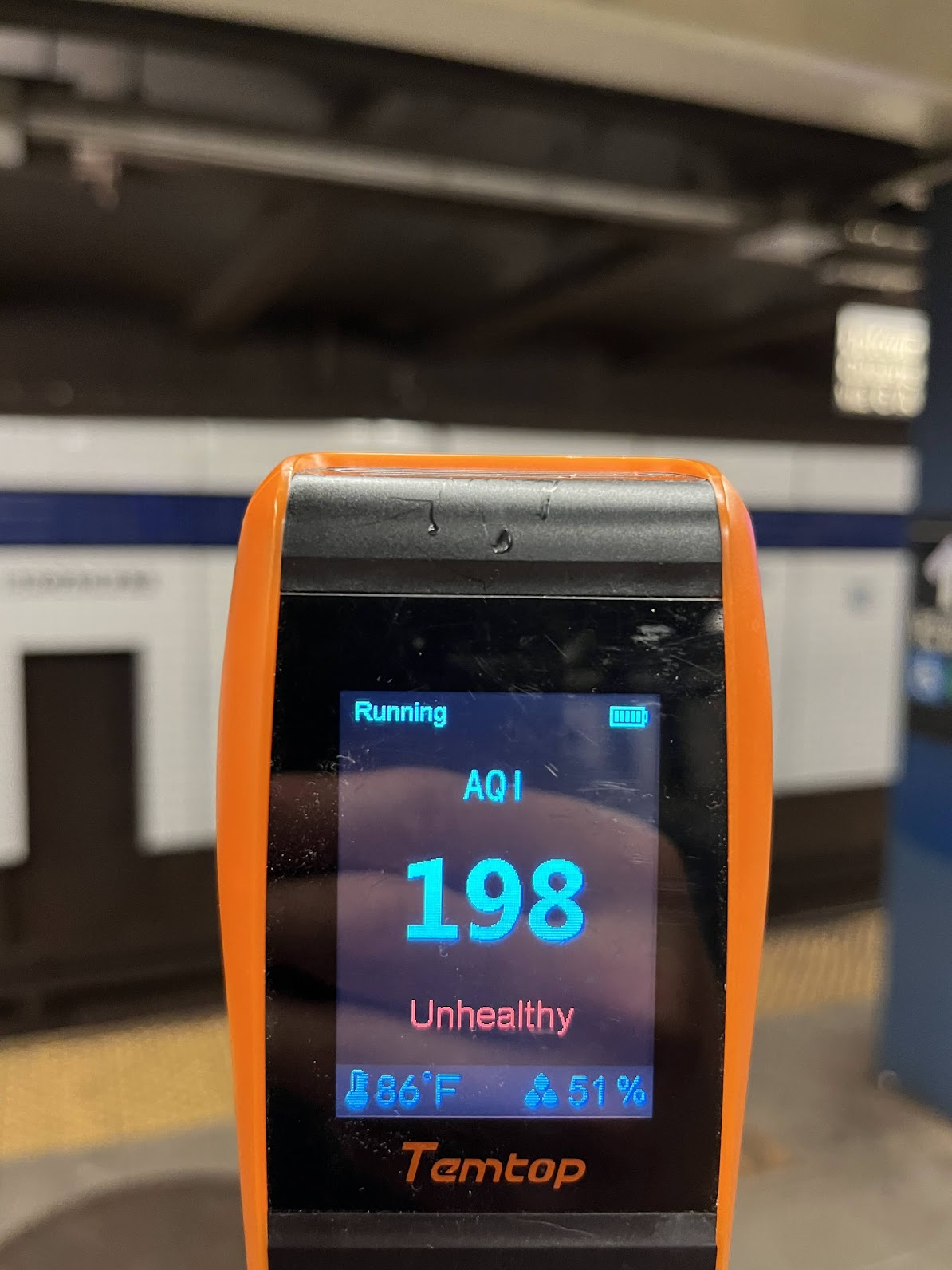
The NYC subway
It’s just bad, bad, bad down there.
It’s so bad that Dynomight calculates that a daily commute from Newark to Manhattan takes a 1/2 year off your life expectancy.
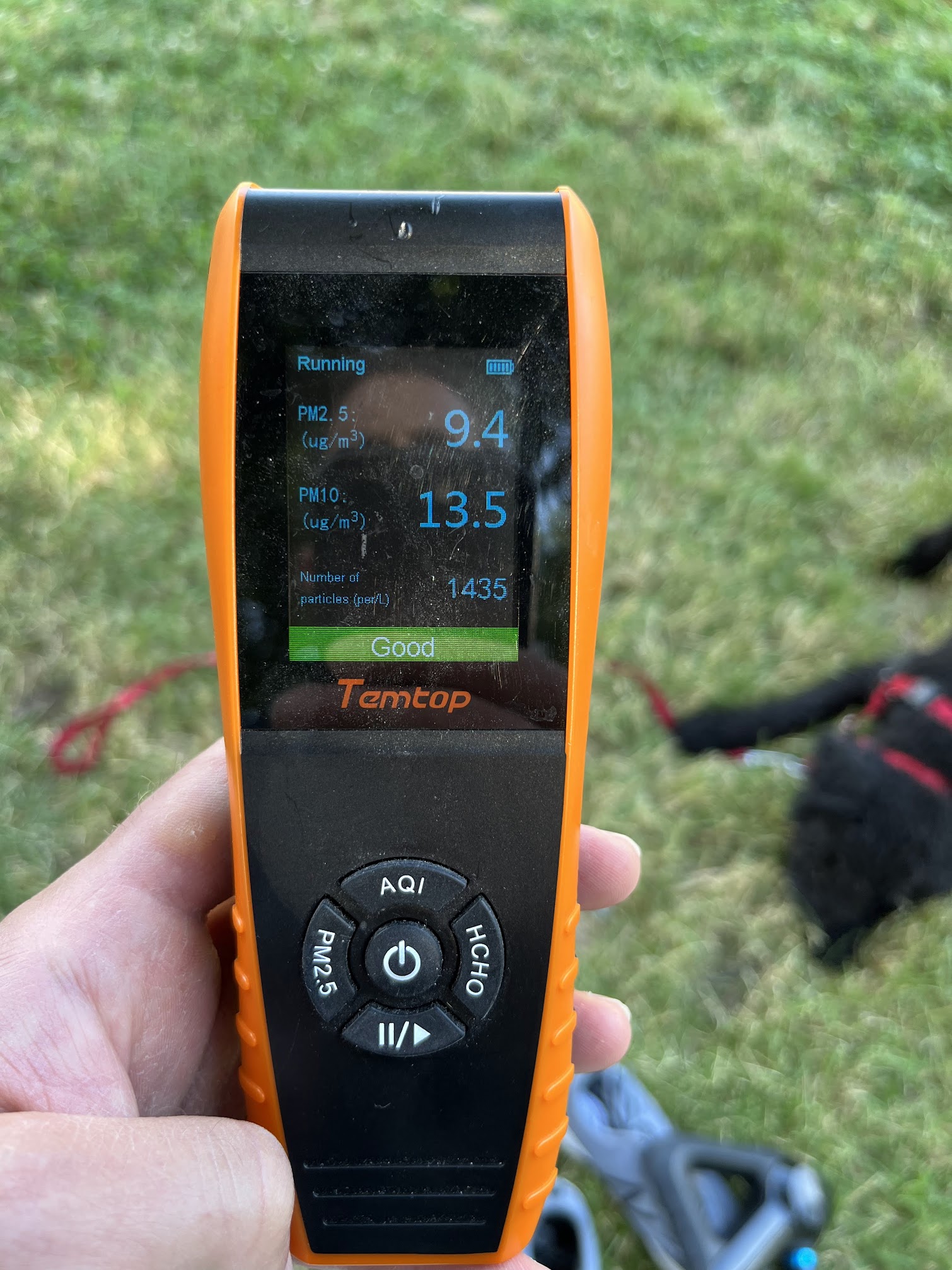
Places that are mostly okay
Prospect Park in Brooklyn.
JFK Airport.
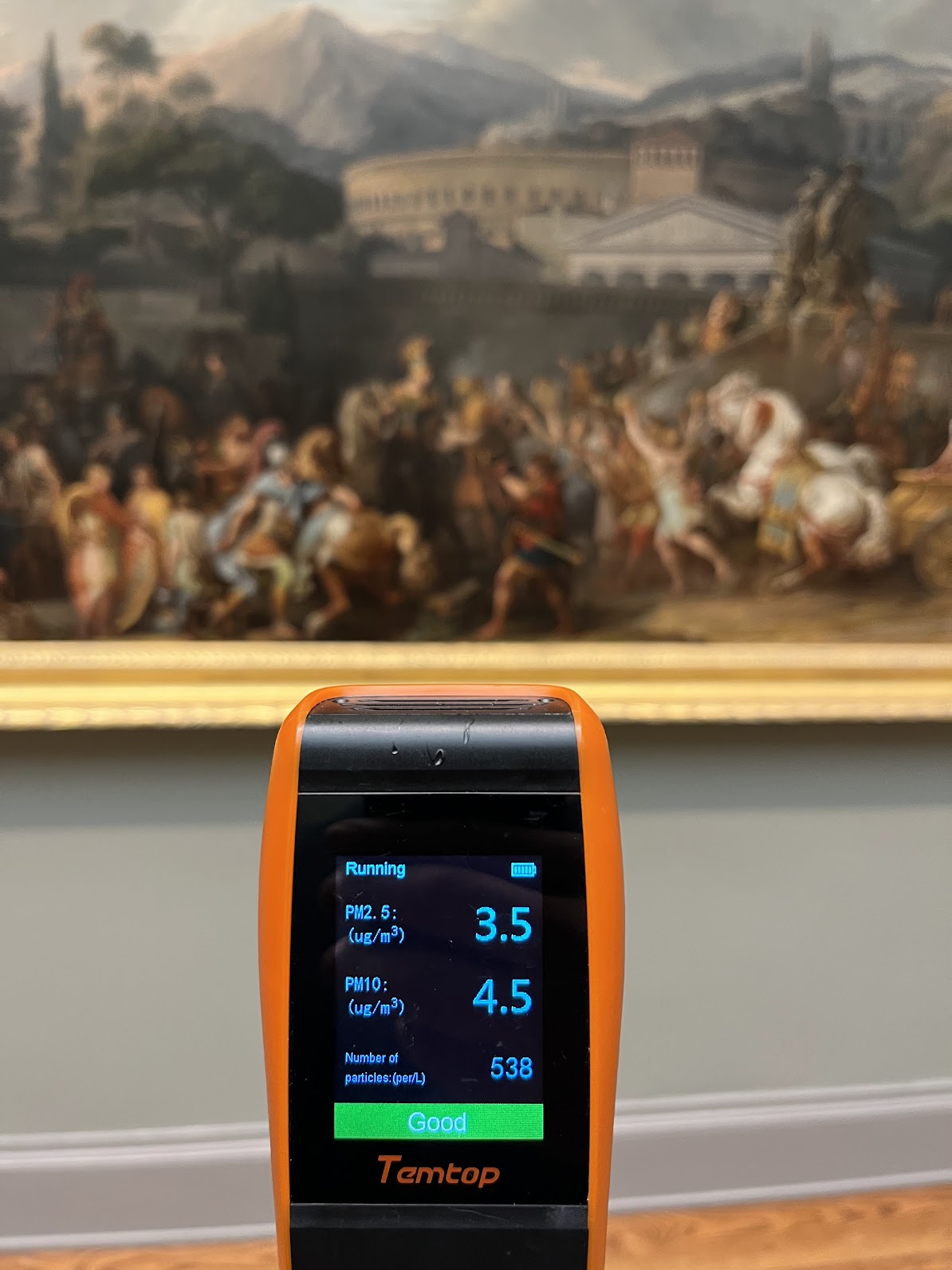
Places that are squeaky clean
The Metropolitan Museum of Art
NYC residents can get in free. Consider hunkering down with the clean air and amazing paintings on particularly high pollution days.
A note on VOCs
VOCs are less of a problem than I would have thought given how much I’ve heard about them in the press. New furniture doesn’t throw many off, nor did our new vinyl flooring in our house. New wall installation was fine. Low VOC paint was as advertised — it made the number go up for a bit but was back down to negligible levels once it dried.
My in-laws basement has really high VOCs for some reason. Cracking a window makes them drop to almost nothing within a minute or two.
I feel like I have a lot more to learn around VOCs, I haven’t spent nearly as much time looking into it as I have small particulate matter.
Stay safe in there!
I didn’t give much thought to indoor air pollution until recently. Now I realize there are simple, low effort ways to breathe cleaner air. That makes me happy.
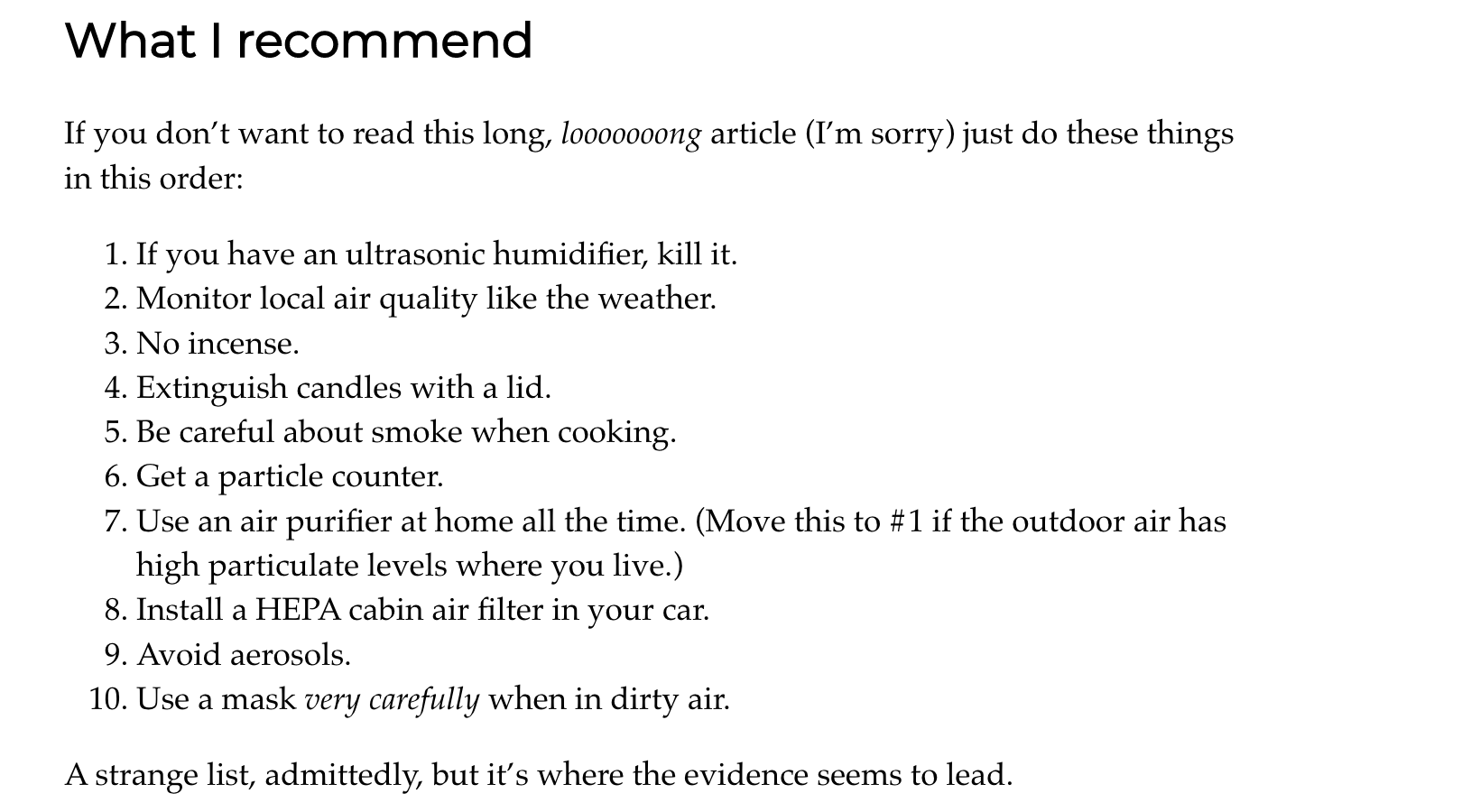
For the curious (and for those that don’t want to read the Dynomight article I keep going on about), here are that person’s takeaways on how to improve indoor air quality, most of which I didn’t get into here:
Here’s to having clean air in 2023 without obsessing about it and turning into the Howard Hughes of fine particulate matter.
Like any good knowledge worker, I’m always on the lookout for legal substances that will help me get through more tasks, faster. It’s crucial to have something at the ready when you’ve got 30 more minutes of call notes to transcribe into Salesforce but you have already exhausted your very will to live.
You can drink caffeine of course. And chew nicotine gum. But you can’t do those too often or they’ll lose their effect. If you also have an addictive personality and you’re kinda worried you’d become a meth addict if you tried Adderall, then you need to look for “natural” ways of getting an energy boost.
That’s when you enter the murky world of nootropics, or so-called smart drugs. There are a zillion nootropics on the market claiming to help boost your energy, and I’ve taken a lot of them. They are mostly useless, at least for me. But that doesn’t stop me from trying new ones. If I can find something even close to caffeine and nicotine it’ll have been worth all the trouble.
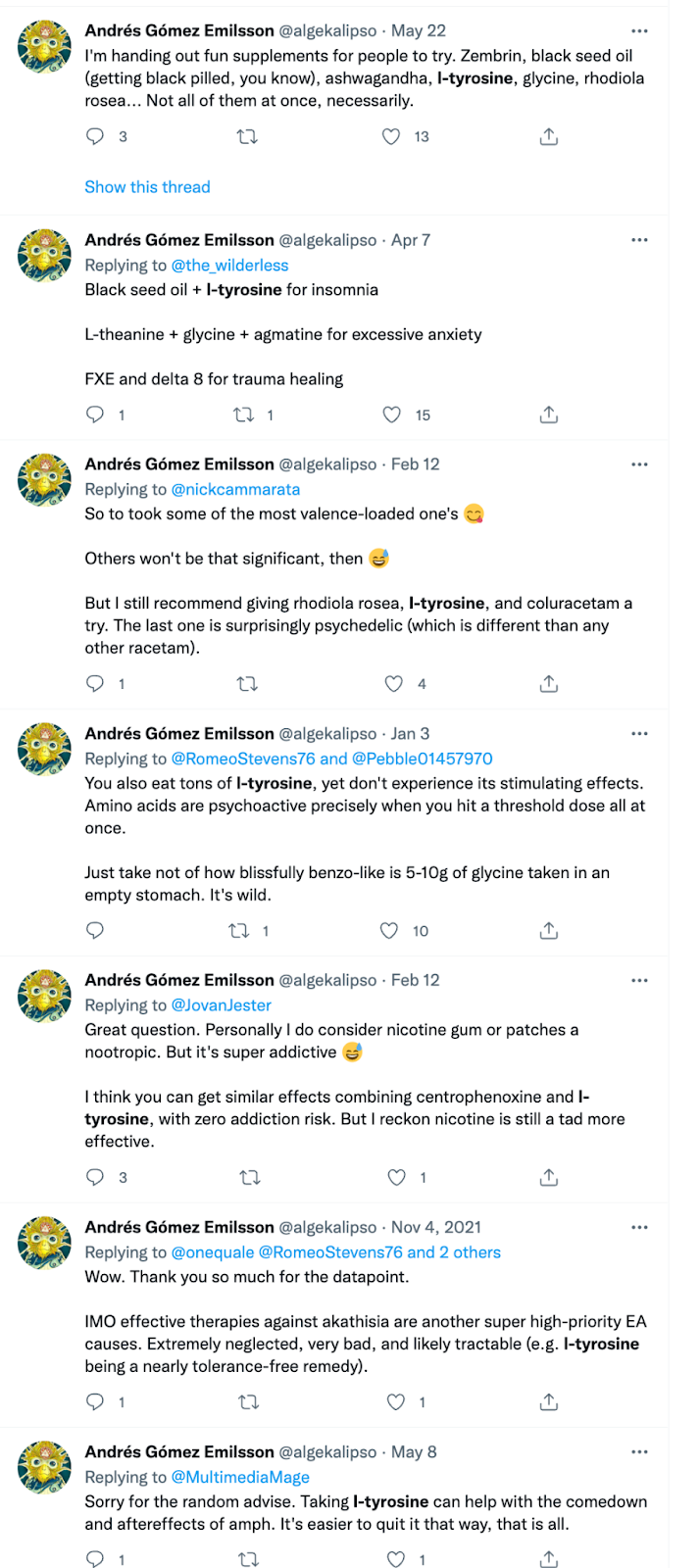
My latest interest, and one that shows great promise, has been a naturally occurring amino acid called L-Tyrosine. I decided to give it a try after seeing the eccentric, fascinating, and brilliant consciousness researcher Andres Gomez Emilsson consistently sing its praises on Twitter. That’s an understatement — he talks it up like he’s on the payroll of Big Amino Acid.
He thinks it’s useful for:
Acting as a safe, addiction-free stimulant with nicotine-like effects
I fully trust this man with the fate of my brain cells
Talk about a wonder drug!
We should all be skeptical of wonder drugs. But we should at try them at least once, yeah?
I’ve been taking L-Tyrosine on and off for about 8 weeks now as well as doing a ton of research to see what it’s all about.
I can’t endorse everything Andres claims, but I do see L-Tyrosine as a cheap and safe way to get a noticeable yet subtle boost of energy. Let’s dive in.
What is L-Tyrosine?
L-Tyrosine is a nonessential amino acid that acts as a key building block for neurotransmitters such as norepinephrine and dopamine.
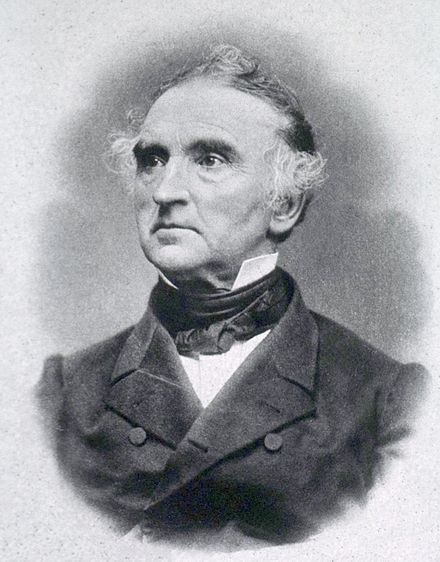
L-Tyrosine was first synthesized by a prolific German scientist named Justus Von Liebig. It’s name comes from the greek word for cheese, because it was first synthesized as part of the cheese byproduct casein. As a vegan who used to love cheese, this makes me happy.
Thank you, Mr. Von Liebig, for helping me have the energy to finish this essay! (And also for creating the fertilizer industry. That’s cool too.)
How does L-Tyrosine boost energy?
If you increase the amount of L-Tyrosine in the body, you boost the production of dopamine and norepinephrine. Those two chemicals have many and various uses in the body, but for our purposes it’s sufficient to know that boosting dopamine and norepinephrine tends to give people more energy.
One study showed that within 45 minutes of taking a 500mg dose of L-Tyrosine, participants had elevated levels of dopamine and norepinephrine for 30 minutes. That makes me feel good about doing a 500mg pill when I want a quick boost to finish some tasks.
Can L-Tyrosine Improve your Brain Function?
It turns out there is a huge body of literature on L-Tyrosine. There is no way I could cover it all, so I only looked at studies on humans that investigated L-Tyrosine’s energy boosting and cognitive enhancing potential. I ignored other studies, such as the ones looking at L-Tyrosine’s effect on the sexual activity of goats. Who am I kidding, I peeked at that one. The L-Tyrosine treated goats had healthier offspring.
That feeling when your mom and dad had tons of L-tyrosine in their system when they made you
Anyway, after spending several hours reviewing dozens of individual studies on L-Tyrosine, I realized someone way smarter than me had probably already done this before.
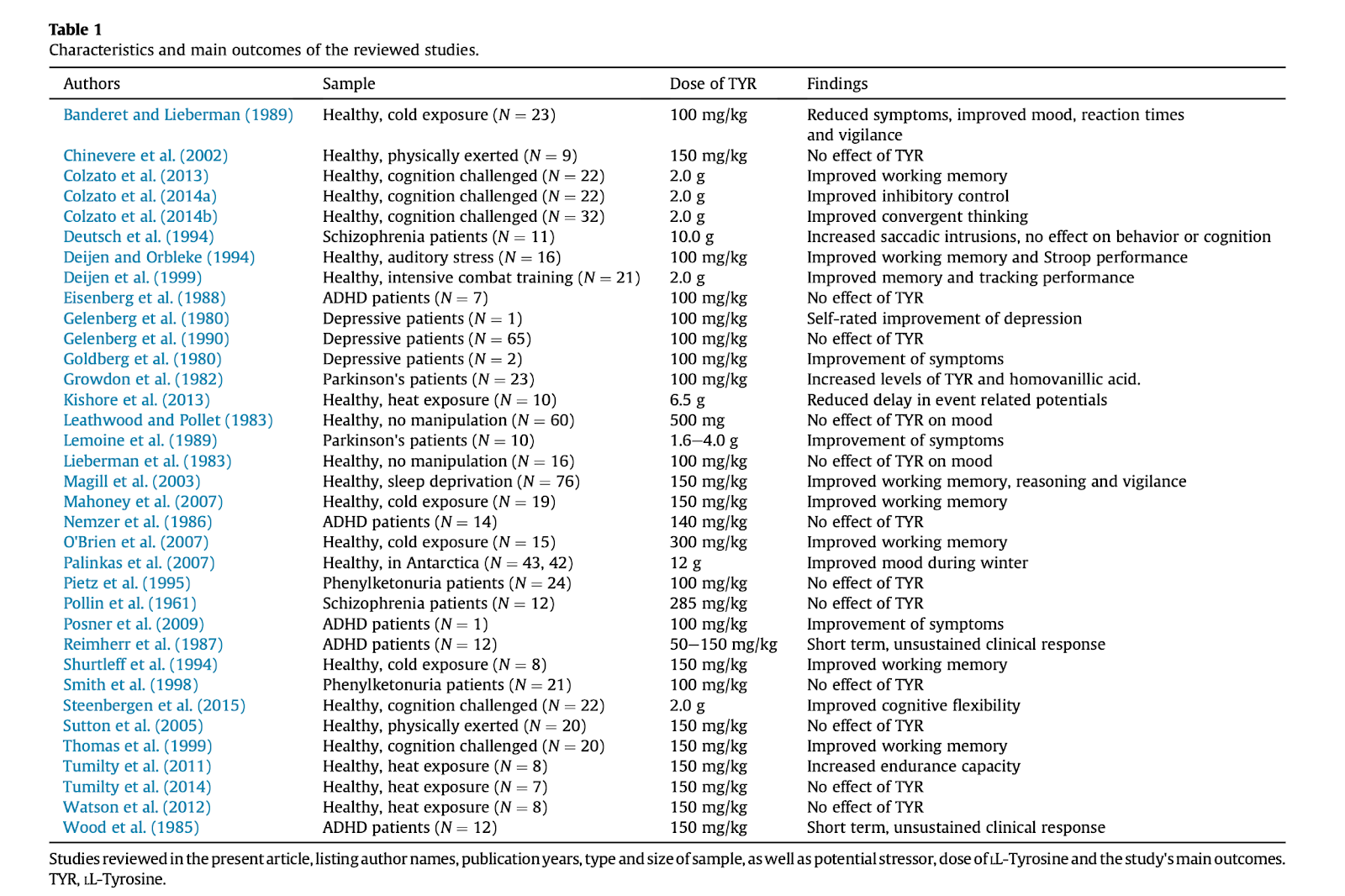
I was right. I found a 2015 meta-review of studies on L-Tyrosine and mental performance. It concludes that L-Tyrosine does help with mental performance once you’re already a bit run down. The authors reviewed 35 studies on L-Tyrosine and say the following in their abstract:
L-Tyrosine does seem to effectively enhance cognitive performance, particularly in short term stressful and/or cognitively demanding situations. We conclude that L-Tyrosine is an effective enhancer of cognition, but only when neurotransmitter function is intact and dopamine and/or norepinephrine is temporarily depleted.
If you’re undergoing some stress and burning through your available dopamine and norepinephrine, L-Tyrosine might help you refill your energy stores so you can maintain your normal functioning.
Another L-Tyrosine literature review I found supports this conclusion, stating that under stressful conditions you can use “acute and dietary administration of tyrosine to prevent the depletion of brain norepinephrine which would otherwise occur.”
The trend I kept seeing is that L-Tyrosine is helpful, but only when someone is stressed. But I didn’t see a standard definition of what stress actually is. Here are some of the ‘stressful’ conditions under which L-Tyrosine appears to improve functioning:
If stress includes situation in which you’re thinking hard for prolonged periods of time, maybe we’re all stressed when working our normal jobs? So L-Tyrosine might be more beneficial than is commonly thought? In my opinion day to day life can stressful for many people, so I wonder if L-Tyrosine can be used in a wider range of situations than most researchers imagine. I might be missing something obvious here.
Maybe a better framing is that L-Tyrosine helps performance on cognitively demanding tasks. That’s the conclusion of this 2013 study using 2mg doses:
The present study is the first to demonstrate that TYR supplementation promotes working memory updating. As expected, the more challenging 2-back condition was more sensitive to the effect of L-Tyrosine, which reinforces our suspicion that only tasks with considerable cognitive demands benefit from L-Tyrosine. As we have argued in the introduction, this may be because more demanding cognitive operations are more likely or more efficient to exhaust the available cognitive resources, which can then be repleted by L-Tyrosine. The idea that cognitive-control operations are particularly likely to exhaust cognitive resources fits with the concept of “ego-depletion” suggested by Baumeister et al. (1998), which would suggest that L-Tyrosine can be used as an effective “ego-repletor.”
If nothing else, I think we can all agree that ego-repletor is a cool word and that we should use it it in non-drug contexts as well.
“You’re not just my best friend, you’re my number one ego-repletor.”
Can L-Tyrosine Make You More Creative?
One study showed L-Tyrosine (at a 2mg dose) helped with a word association task. The author of the study take this to mean that L-Tyrosine “may promote convergent thinking in inexpensive, efficient, and healthy ways, thus supporting the creative process that Steve Jobs was so fond of. ”
That feels like a bit of a stretch to me. I can’t say I’ve felt any more creative on L-Tyrosine. I also think it’s amusing that the authors end their scientific research paper with a totally out of left field reference to Steve Jobs. I mean, sure, he was a fan of the creative process, but so were a lot of people!
“Eat a lot of L-Tyrosine to think different” was less catchy
What Dose of L-Tyrosine Should You Take?
All L-Tyrosine studies appear to have one of two approaches to dosing:
Give someone a little bit (500mg – 2g)
Load people up with L-Tyrosine until it’s coming out their ears (150mg-300mg per kg of body weight)
It’s strange, there appears to be no in-between! The high doses might be due to the fact that you need about 100mg/kg in order to double your plasma tyrosine levels. Maybe that’s what many researchers are shooting for? I wasn’t able to find anything around why that would be.
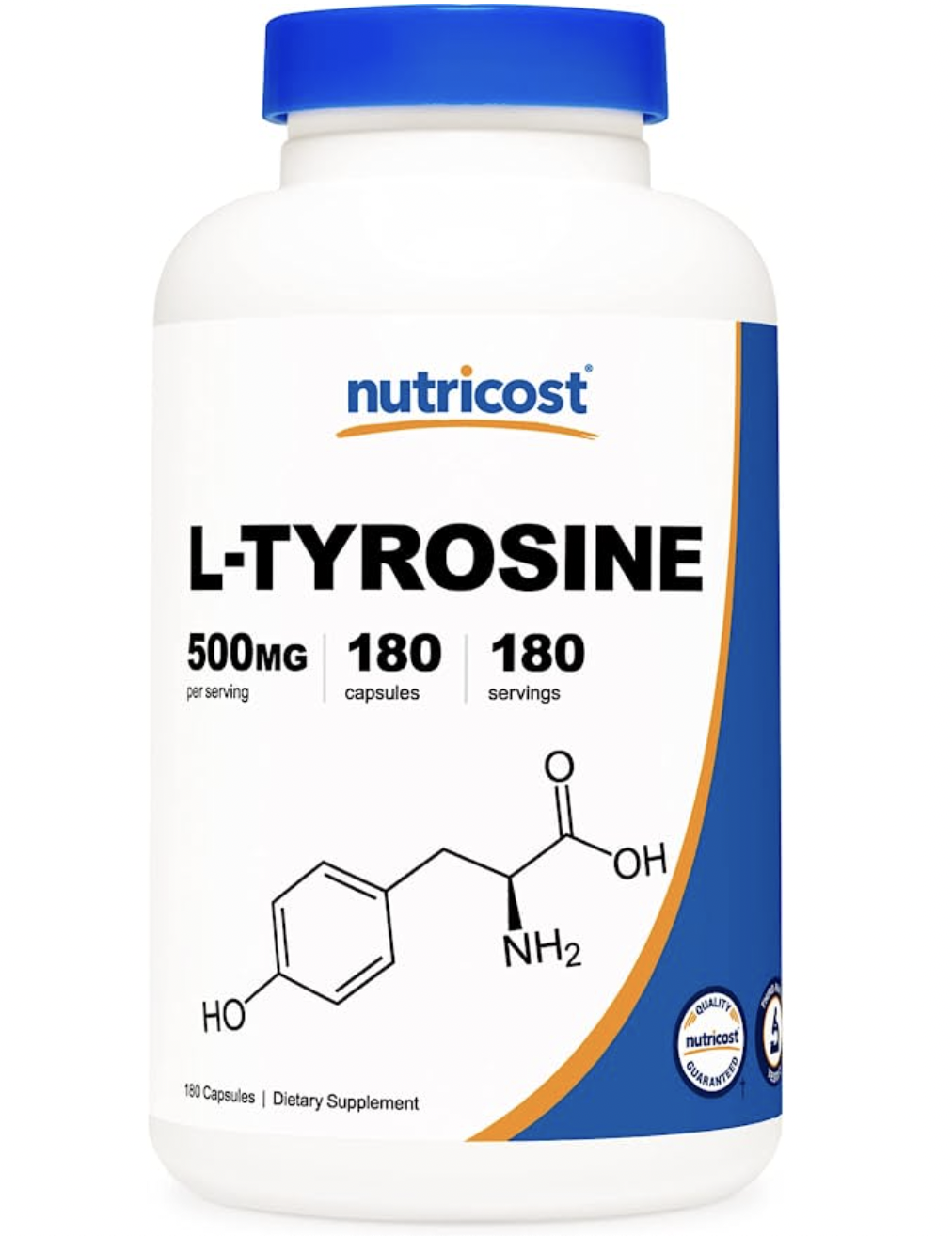
As a 90kg person, taking 150mg/kg is the equivalent of taking 13.5 grams of L-Tyrosine, or 27 (!) of my 500mg pills at once.
I have yet to try the higher doses. I couldn’t afford to do that for very long, and it just feels extreme? But maybe I’ll give it a go one time just to see what happens.
Depending on your approach this could be 180 servings or 7 servings 😳
Thankfully, there are plenty of studies showing cognitive enhancing abilities in the 2 grams or less range. I’m going to bank on that lower dose being effective for me.
I also want to note that some studies have shown positive effects with doses as low as 100mg per day. That was the case in some small scale trials where L-Tyrosine was given to Parkinson’s patients. I’m left thinking there is still a ton to learn here about dosing and I’m curious to see how the field develops.
My personal experience with L-Tyrosine
I’ve been taking L-Tyrosine about 4 days a week for a couple months. I find a 500mg to 2g dose to be mildly stimulating when used in the afternoon. I also feel it gives me a better ability to focus. Overall, it provides a sustained, non-jittery energy boost for a couple of hours. This is very helpful for getting through the all-to-common afternoon slump. I once took 3g dose after a poor night of sleep and it seemed to help my energy levels quite a bit.
I don’t get a big energy kick with L-Tyrosine like with caffeine or nicotine. It’s more of a subtle boost. And I take L-Tyrosine in the afternoon it has a way more noticeable effect than if I take it in the morning. I honestly can’t really notice it if I take it in the morning. Probably because I drink coffee every morning too.
All that does make me wonder how much of the effects are placebo. I am finding it helpful in the exact situations all the studies say it should be helpful, which is when I am depleted from a morning of work and staring down the barrel of a couple more hours of things that need to get done.
This either means it actually works or I’ve convinced myself it should work. Or some combo. Either way, I am happy with the results.
I don’t notice any withdrawal the next day, and I don’t notice any strong cravings or a comedown like with coffee.
Overall I think it’s great, but you won’t see me on TikTok contributing to the trend of people calling L-Tyrosine “natural Adderall.”
I guess people also say it will give you a natural tan?? I couldn’t find evidence of that, but I would welcome it as a side effect
I’ve noticed my sleep being slightly worse since I’ve started my experiment, but I’ve also had other changes going on that could be confounding factors. I unfortunately don’t wear a sleep tracker at night anymore so I have no hard data around this.
As far as the claim that it only works when the brain is “depleted,” I find that hard to test. I consider all my work to be cognitively demanding, so it’s hard to parcel out specific parts where I feel like Tyrosine is helping me more than others. I need to try paying more specific attention to if I have been able to sustain higher energy for longer periods of time in the past couple months. My performance and reviews at work have been excellent lately, so maybe that counts for something?
My wife noticed that my breath gets an odd, slightly metallic smell when I take L-Tyrosine, even at the 500mg dose. When I take 2g she notices it right away.
It’s not bad breath necessarily, just weird. Or maybe she’s just telling me that to be nice. I have a poor sense of smell and would never even notice anything was off.
This doesn’t seem great, but I’m not too worried about it. If my wife can’t handle it that would be an unfortunate deal breaker. For our relationship. L-Tyro for life! JK, I’ll have to go on a new nootropic hunt if the weird breath becomes a quality of life issue.
Is it Risky to Use L-Tyrosine?
L-Tyrosine is generally recognized as safe by the FDA. You can take very large amounts for months at a time without causing significant harm. While you would likely build a tolerance taking mega doses all the time, I am encouraged by the fact that I have never heard of an L-Tyrosine addict. It doesn’t get you high. That said, I’m sure taking it all the time would lead to tolerance, and repeatedly boosting dopamine and norepinephrine has to have some downsides? I’d use your own judgement and common sense — don’t take it every day, watch out for escalating use.
The main risks I came across in the scientific literature have to do with it’s potential to interact with other drugs. It might interacts poorly with MAOIs and if you’re already on thyroid medicine or if you take L-Dopa for Parkinson’s you also probably want to steer clear.
L-Tyrosine — Fan Favorite
While writing this post I stumbled into a nerdy part of twitter where scientists are running a (totally unscientific) bracket to determine the best amino acid. As of this writing, L-Tyrosine is in the final four and is winning it’s matchup! If that doesn’t convince you of its goodness, I don’t know what will.
I’ll be sure to update everyone when the voting is complete. I am sure everyone is on pins and needles, wondering if L-Tyrosine can take down the mighty Tryptophan in the finals.
I’m excited about the potential of L-Tyrosine. While there is not a ton of research at the dosages a normal person would take, those that did look at a 500mg to 2g intake show promising results.
It’s a substance that is safe to try if you are struggling with energy and want a low cost solution that isn’t some mystery chemical cooked up in a lab. It’s just an amino acid that you are already consuming anyway. And a large bottle of 500mg capsules will only run you like 20 USD.
Ideally, we’d all be fully optimized humans who get the perfect amount of sunlight, exercise, fresh food, and soulful interaction with friends and family. Plus we’d work a job we love that doesn’t require us to push the limits of our mental capacities if we don’t want to. I truly wish that existence for anyone, and someone living like that might not even need coffee to feel like their best self, let alone L-Tyrosine. They could be high on life in the truest sense of the word.
Until I get to that point, I’ll continue to explore nootropics. I’m glad I discovered L-Tyrosine and that I now have another weapon in my stress fighting arsenal.